
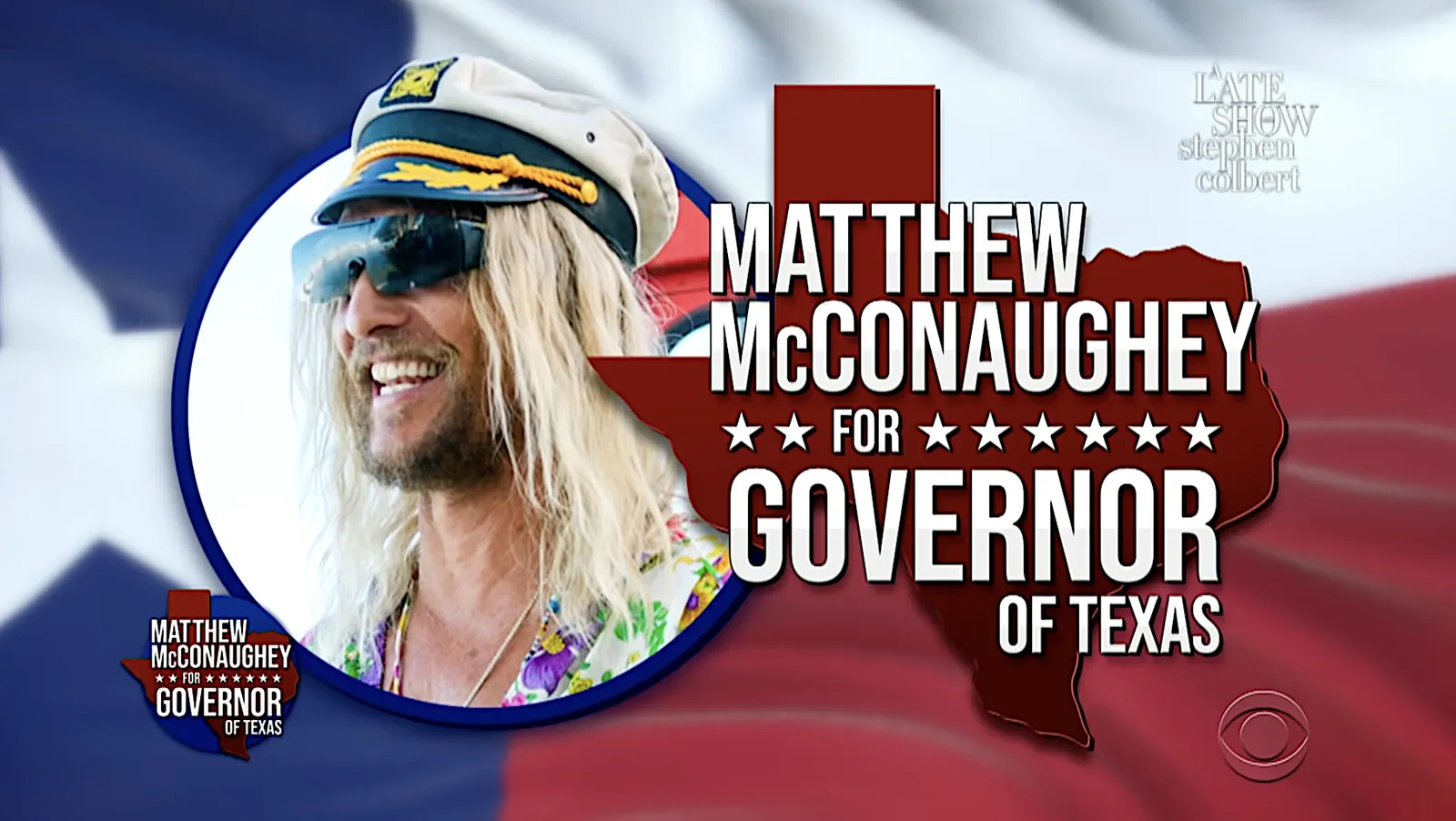
Jon Liedtke joins 610 CKTB’s Gene Valaitis for his regular weekly segment, Liedtke’s Got a Take!
Liedtke argues Matthew McConaughey is mounting a long-game shadow campaign for Texas Governor. Citing his book Greenlights, YouTube videos, Apple TV’s Brothers, and audio newsletter, Liedtke showed how McConaughey built a turnkey political machine to bypass party gridlock and defeat voter cynicism with centrist populism.
Transcript (Gemini Generated):
Gene Valaitis: It’s Friday, and on Friday we try to have a little bit of fun with Liedtke’s Got a Take. Good morning, Jon.
Jon Liedtke: Good morning, Gene!
Gene Valaitis: Well, let me just start off by saying: Alright, alright, alright! We’re talking about Matthew McConaughey playing the long game to possibly being the Governor of Texas. Now, you know, it’s interesting—he’s got that show on Apple TV, Brothers, and that’s sort of like simulating a campaign. So Jon, he claims he’s staying home until his kids leave, but if an earlier political opening pops up, could we see him really pulling the trigger way before 2030 and taking a serious run at either being the next Governor of Texas or even the President of the United States? Alright, alright, alright!
Jon Liedtke: Alright, alright, alright! Now Gene, I mean look, focusing on family, that’s the oldest, safest dodge in American politics. That’s like literally out of Politics 101. And I don’t doubt he wants to be a dad first, but anyone who watches politics from the operating side of things and sees the infrastructure that he’s assembling, they know what’s going on and it’s all in plain sight. Every single piece of his media footprint is doubling as a turnkey campaign machine. He first established his origin story and his personal philosophies in his book Greenlights, which came out a few years ago. He’s got a YouTube channel that is talking about, you know, just his life, but he’ll also sometimes veer into very political things, talking about America on its 250th anniversary and what it stands for. He’s just talked about the need for an independent track in American politics and how independents are the ones who actually hold the true power. Then there’s the Apple TV show, Brothers, that’s acting as a multi-million dollar focus group paid for by Apple. And he’s got a newsletter that he puts out every week with an audio monologue associated with it that’s also translated by AI into Spanish, which of course is the language of a large demographic in the United States, and that serves as a clear opening in whether it to be just Texas or nationally. And so when it comes time to him deciding to pull the trigger, he won’t have to build a political machine from scratch, he just has to turn the key, start driving, and say, “Alright, alright, alright.”
Gene Valaitis: Well, you know, he wouldn’t be the first actor to go after a political office. You know, I’m thinking of this one guy who had a pretty good run, his name was Ronald Reagan; Arnold Schwarzenegger did okay in California. But now you’re saying he’s eyeing a governor’s run instead of the White House. So why is a governor’s mansion the real springboard for a long-time candidate like somebody like Matthew McConaughey?
Jon Liedtke: You know, I think state power is the ultimate outsider play if you’re just jumping into things. You don’t jump straight into the Washington swamp, realistically, even though Trump was able to pull that off. But I think that proving you can manage a massive economic powerhouse like Texas first is a model. As you said, that’s the Reagan model, that’s the Schwarzenegger model. And again, look more at that show on Apple TV, Brothers—he’s effectively test driving the gubernatorial run on prime time. And that’s not just sitcom plot filler, it’s real-time messaging tests. He’s playing the governor on our TV screens, he’s gauging voter reaction to the episodes, and if the narrative can hold in Austin, he’ll have a direct and unassailable springboard to national influence without ever having to sit through a legislative subcommittee.
Gene Valaitis: (Laughs) You know, in a political landscape dominated by loud fringes, can an aggressively centrist, independent, libertarian sort of a guy, can he actually break through all that noise in the US?
Jon Liedtke: I think someone like Matthew McConaughey could absolutely break through all the noise that’s going on as an independent centrist, aggressively so, because people are so thoroughly exhausted by party apparatuses that cater exclusively to loud, fringe bases on the extremes. I mean, McConaughey’s entire pitch, and he talks about it in one of his videos, targets the vast majority of voters that he says are living between the 40-yard lines who are routinely ignored by the primary system that’s designed for ideologues. So, you know, when a high-profile figure like Matthew McConaughey can come forward with universal name recognition, step up and argue that taking sensible positions from both sides isn’t indecision, it’s actually judgment, it’ll land. And he strips away the beltway jargon, he can replace it with plainspoken common sense, and in a sea of performative outrage amplified by social media and AI, I think straightforward realism actually sort of feels radical.
Gene Valaitis: Yeah. Let’s go back to our childhoods here, Jon, let me play pretend. Say he actually wins as an independent, how does he govern without a party?
Jon Liedtke: Um, you know, I think by completely bypassing the legislature and going straight over their heads to the public. He doesn’t need to have a legislative caucus when he controls a direct line to millions of voters, quite frankly, and citizens through his media platforms, his podcasting reach, and his cultural footprint—not to mention on the silver screen as well, broadly. So if a partisan statehouse tries to stonewall his basic governance, he wouldn’t have to waste time in backroom committee bargaining. He could literally just turn on his camera, go live to YouTube, and call out the obstructionism in plain English. Yeah, he can turn public sentiment into leverage, he could make the cost of partisan stonewalling far higher for local representatives than working with him.
Gene Valaitis: Yeah. I’ve mentioned on the air a couple of times, I lived in Dallas for three years, had a great time, but boy, they take their politics very, very seriously in Texas. So if the party machines try to block his agenda, doesn’t picking a fight with Governor Matthew McConaughey basically mean you’re picking a fight with Texas?
Jon Liedtke: Yeah, you know, you don’t want to go and pick a fight with Texas, that’d be ridiculous, and that’s how I see this. I think that the way that Matthew McConaughey can frame the entire thing is how he frames his entire identity, and it wouldn’t have to be as a partisan hack, but as an embodiment of state pride. And if political operatives try to stall pragmatic legislation just to score partisan points, he can turn that into a simple narrative of hyperpartisan paralysis versus the actual interests of the voters. And at that point, state representatives, again, they wouldn’t just be fighting an independent governor in the executive office in the governor’s mansion, they’d be actively, openly opposing their own constituents to protect the party bosses. And that’s a political suicide mission in any election cycle.
Gene Valaitis: You know, I think a lot of would-be politicians in Canada should really study this, because, you know, we’re all about party here, and it’s never been really any different. At the end of the day, is his biggest hurdle the party machine, because he’s talking about common-sense government, not just, you know, lockstepping in with what the party has to say. Um, is it, is it possible?
Jon Liedtke: You know, I think that the biggest hurdle that he’d be facing would actually be the institutional cynicism of it. But the party machine, I mean, that can be outmaneuvered, although it’s tough, but entrenched voter apathy, that is, that’s the far tougher beast in my opinion. I mean, people have been burned by administrative incompetence and performative politics—and we see this here in Canada as well, and it’s been going on for so long—that people assume, you know, that actual effective, pragmatic governance is a pipe dream. And when I say that it’s been happening here, I don’t mean at any one specific government, but I think people can feel that whether they look at their local government, their provincial, or the federal one to a certain extent. So Matthew McConaughey’s hardest task isn’t beating a rival candidate on the ballot, it’ll be convincing an exhausted electorate that common-sense leadership isn’t actually just a Hollywood trope and it’s something that they can have. So if he’s able to, or if any politician is able to crack through that type of cynical armor and get people to re-engage with the process, I think the rest falls into place.
Gene Valaitis: Yeah. I guess the only person who came close to doing this in Canada was Preston Manning. Do you agree?
Jon Liedtke: Yeah, you know, that’s a really interesting way to look at it, and I would say, you know, as of late, I think he’s seen more in a hyper, hyperpartisan lens rather than just through a pragmatic lens, but yeah, I would agree with you on that sentiment.
Gene Valaitis: Yeah. An interesting take this Friday morning, and say it with me, Jon: Alright, alright, alright!
Jon Liedtke: (Laughs) Alright, alright, alright! Talk to you on Monday, Gene. Have a great weekend!
Gene Valaitis: Thank you. Liedtke’s Got a Take, he’s back on Monday.
This aired on 610 CKTB
Leave a Reply