
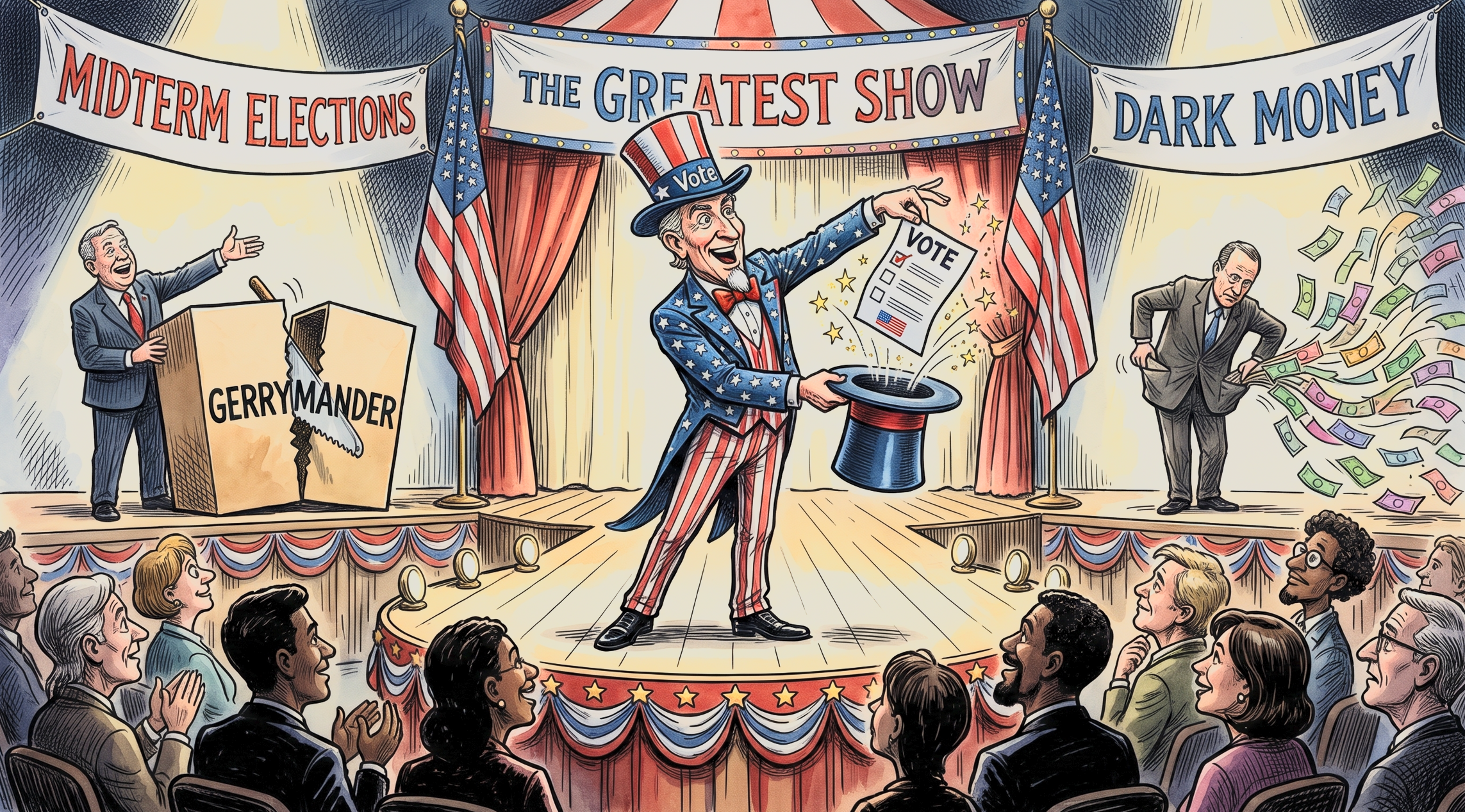
Jon Liedtke breaks down U.S. midterm campaign dirty tricks, from Alaska’s decoy “Dan Sullivan” candidate to $180M in unregulated AI deepfakes. Highlighting historical election hoaxes in both nations, he warned that regardless of the winner, American protectionism and trade friction directly inflate Canadian household bills.
Jon Liedtke joins 610 CKTB’s Gene Valaitis for his regular weekly segment, Liedtke’s Got a Take!
Transcript (Gemini Generated):
Gene Valaitis: It is time for another episode of Liedtke’s Got a Take, featuring the one, the only, Jon Liedtke. And good morning!
Jon Liedtke: Good morning.
Gene Valaitis: Well, Johnny, Midterm Election Day in the U.S., and it’s—it’s been a mess for the last couple of weeks. What with Trump talking about men’s rear ends, Nicki Minaj’s rear end, Arnold Palmer’s body parts… In Alaska, voters have to find out which candidate they’re actually voting for: which Dan Sullivan is the Republican incumbent who’s running against some other guy named Dan Sullivan. [Sighs] It—I mean, I mean, the guy’s currently legally on the ballot, but watching from our perspective here in Ontario, is this a brilliant political trickery or—or just pure absurdity?
Jon Liedtke: You know, for me, Gene, I’m just enjoying the show. This is low-budget political theater. I mean, think about the sheer volume of digital ink and breath we’ve wasted on high-tech conspiracy fever dreams over the past few cycles. We’ve heard about Jewish space lasers, Italian satellites flipping votes, people hunting for microscopic bamboo fibers in Arizona ballots… Throw all that out the window. If you want to throw a wrench into the election, you don’t need an algorithm, you don’t need a server farm. You just need another guy named Dan. [Gene chuckles] It’s cheap, it takes zero technical sophistication, it’s pure comedic mischief. Um, you know, if—if Sarah Palin, she once said that she could see Russia from her front porch in Alaska. Well, looking across the river from Windsor at Detroit, I’m pretty sure the river is getting filled up with Republican sweat right now. [Gene chuckles]
Gene Valaitis: Yeah. Well, down south, we’re seeing a—a real high-tech campaign with a lot of tricks, with over 180 million pumped into artificial intelligence ads. There have been videos of candidates coloring in Bibles, admitting to corruption, with no regulations and fewer than 30% carrying disclaimers. Um, we hear plenty of panic about AI, but who’s actually enabling and profiting off this wave of what can only be described as digital slop?
Jon Liedtke: [Laughs] Follow the money! Silicon Valley is working both sides of the street and cashing checks at every turn. I mean, they’ve turned political deception into an end-to-end business model. They buy and sell the machine learning engines that spit out the fake videos—AI—and then they turn around and charge the campaigns hundreds of millions of bucks to broadcast and micro-target that slop across all their platforms. They’re monetizing the erosion, end-to-end. It’s basic reality erosion.
Meanwhile, Fed regulators and lawmakers have been paralyzed by how quick it is, dragging their feet on this issue, quite frankly because, you know, so many people that are in politics are unfortunately, you know, old—too old to understand what most of this software really is. I mean, I think there was a poll of them recently, they don’t really understand exactly how social media works, for gosh sake.
So, the tech platforms love to hide behind boilerplate claiming they’re just neutral conduits, but that’s just—it’s nonsense. They’re not neutral pipes. They’re the arms dealers and the broadcast towers profiting off of the chaos, but at least when it comes to the U.S. election, we get to watch it rather than be involved in it.
Gene Valaitis: Yeah. You know, whether it’s an AI ad, a duplicate name on a ballot like up in Alaska, illicit robocalls… Oh, and yesterday on X, I saw a video of a woman who is now just coming forward, two days before the midterms; she’s in her mid-30s claiming that Donald Trump assaulted her when she was seven. Um, all these political dirty tricks, they’re as old as the continent itself. We’ve seen them for years and years. So, what are your top two dirtiest political tricks in history on each side of the border, I’m curious?
Jon Liedtke: Yeah, I went through, uh, last night and put these together for you for this one.
So, in 1800 in the U.S., the Federalist newspapers ran front-page reports that Thomas Jefferson died of fever. Dead! He was just dead. The lie ran uncontested for three full weeks. The whole goal was to spook electors out of casting their ballots for a dead man. I mean, why would you do that? So, no algorithms, no bots, just the blunt-force con of: “He’s dead!” It was brutal, it was ruthless, and at the time it took three weeks to disprove it.
Second, this was during Nixon’s dirty tricks campaigns that would eventually lead to him, uh, and Watergate and leaving office. In ’72, the “Canuck Letter”. This is so funny. They wanted to get the Democratic front-runner Ed Muskie out of the race, so they had a fake letter written up that said that he condoned a slur—”Canuck”—against French-Canadians. There was actually enough fallout during this election campaign for him that it caused it to tank his campaign, and it actually helped to blow the lid off of Watergate eventually, and it managed to drag Canada into the mess. So that’s on their side.
On our side, who can forget in 2011, “Pierre Poutine” and the robo-calls, of course, sending people to the wrong polling stations, Separatist Street…
And then, this was really good: in 1917, the Wartime Elections Act. Prime Minister Borden had a resistance over conscription, so he used the power of the state to rewrite the election. He gave the vote to female relatives of overseas soldiers who were backing the war, while at the same time stripping the voting rights of naturalized immigrant “enemy aliens,” quote-unquote. That was brazen at the time. Still is.
Gene Valaitis: Yeah. Here’s what I’m worried about: if the Republicans take a beating, or if the results end up being deadlocked, you know, we might hear Trump saying, you know, “It was rigged, it was rigged, it was rigged”. I—I think based on his campaigning and—and what he’s been talking about, who knows, maybe martial law? Or is there a very real possibility that Washington points its fingers north and starts up the whole “Canada is meddling in our election trade” routine?
Jon Liedtke: You know, look across the river from Windsor and we know the script. The second things go sour in American domestic politics, Washington will always look for a scapegoat, and right now we’re right here with a target on us and, you know, all the lights on.
Um, we’ve already seen this bad-faith rhetoric play out, American officials of course crying foul over our anti-tariff messaging, saying it’s foreign interference. That’s hypocritical, and it’s meant to distract the base. But Ottawa can’t afford to handle this by rolling over or curling into a defensive bunker. Canada needs backbones, and we have to defend the Windsor-Detroit industrial corridor, hold the line on cross-border trade, and assert our legal economic rights without getting sucked into their hyper-partisan soap opera, which is going to be a very tough thing to do because regardless of which way the vote goes, it’ll be a soap opera. But you can’t, and you don’t, appease a bully by apologizing for your existence. So this is something that us Canadians are going to have to try to figure out—just don’t apologize instinctively.
Gene Valaitis: [Laughs] But we always say, “I’m sorry”.
Jon Liedtke: Yeah, I’m sorry about that, Gene! [Both laugh]
Gene Valaitis: Listen, Canadians can laugh at the circus, um, but between the tariff war, supply chain standoffs, rising gas prices in Canada, the price of groceries driven by foreign conflicts—how does this outcome hit everyday families?
Jon Liedtke: You know, Canadians love watching the American circus from the comfort of our couches with a bowl of popcorn, but our households are the ones who still get handed the bill inadvertently. When Washington ratchets up the threats, retaliatory tariffs snap into place. When international conflicts escalate energy prices and bottleneck shipping lanes, every single cost increase trickles down directly onto our economy as well.
You don’t feel it in theoretical policy white papers; you feel it in the grocery checkout in St. Catharines, I feel it here at the Windsor gas pumps. So, you know, we can laugh, of course, at having two Dan Sullivans on the ballot in Alaska, but until we lock down cross-border trade stability and we stop taking economic punches from protectionist tantrums down south, everyday Canadian working families will remain squarely in the crosshairs.
So again, I’m glad that the United States president and our Prime Minister are having conversations on the phone. I want to see a deal, and then I want to see it signed if it’s a good one, but let’s get there.
Gene Valaitis: Yeah, absolutely. Another great take. We’ll talk to you Thursday.
Jon Liedtke: Looking forward to it. Thank you, Gene.
Gene Valaitis: Jon Liedtke, Liedtke’s Got a Take.
This aired on 610 CKTB
Leave a Reply