
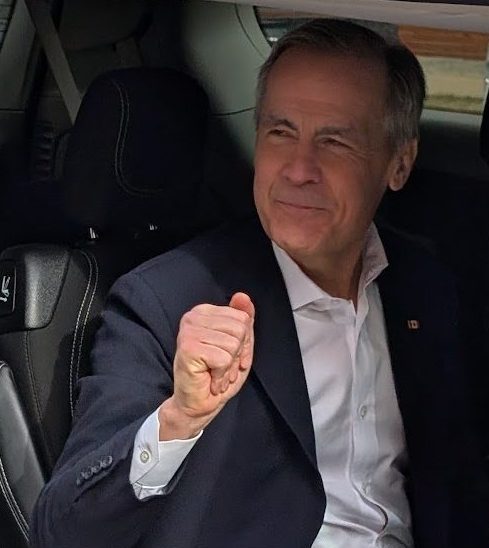
Jon Liedtke joins 610 CKTB’s Gene Valaitis for his regular weekly segment, Liedtke’s Got a Take!
Jon Liedtke discusses Canada walking away from US trade talks, praising the decision to defend Canadian sovereignty against US demands. He calls for removing interprovincial trade barriers, unifying the national economy, ending government booze bans, and adopting a pragmatic, independent national strategy.
Transcript (Gemini Generated):
Gene Valaitis: It’s another edition of Liedtke’s Got a Take. Good morning, Johnny.
Jon Liedtke: Good morning.
Gene Valaitis: Okay, so your take this morning: was Carney right to walk away from Trump? He pulled our negotiators out of Washington. Hey, remember when I said if I could make a bet last week on Polymarket, I would bet that the deal was going to die? I could have made a fortune had if they only accepted bets from Ontario [laughter].
Jon Liedtke: Yeah, but you were saying, though, that you expected that the deal would die because of Trump walking.
Gene Valaitis: Yeah. Well, if I if I bet that it was just going to die, I would have won if [laughter] if they had only taken a bet. Hey, listen, did, did the Prime Minister and Ottawa make the right call in your opinion?
Jon Liedtke: You know, based on the information that we’ve garnered from the Canadian side, yeah. Carney made 100% the correct call pulling our team home. Mutually beneficial trade is fine, but subjugation to another country would be treasonous, quite frankly. Washington, from what we know, tried to dictate who Canada can trade can trade with globally, tried to launch an attack on French language equality not only in Quebec, but also across the country through CanCon, and attempted to strip our digital sovereignty as well. The US doesn’t get to decide how Canada trades, who we trade with, when we trade, full stop. So walking away from a bad deal isn’t just a negotiating tactic, I mean, that’s the bare minimum to maintain and remain a sovereign nation.
Gene Valaitis: Yeah, you know I mentioned this to Laura Babcock at 9:15. The whole notion that Canada, if it wants to trade with another country, would have to say, “Excuse me, Donald Trump, do you mind if we, you know, talk to fill-in-the-blank country?” I mean, that’s outrageous.
Jon Liedtke: Yeah, it absolutely is. And I don’t know if it’s a, what’s a full carte blanche, like they get to stop trade with other countries or they have to approve it, or maybe it was right of first refusal for our critical minerals, for example. But again, these are things that we don’t know, we’re sort of in a black box, and we’re just sort of taking people’s words for it. But the what we’re hearing from the US side is very different than what’s coming out from the Canadian side, so there needs to be a full accounting of what actually happened.
Gene Valaitis: Yeah, well, you know, if this is truly an national emergency, is the government handling things to maintain the trust of we Canadians?
Jon Liedtke: I think they’re going to maintain the trust of Canadian of, excuse me, of Liberals, but I think Canadians more broadly, what we’re seeing is a bit of a hypocrisy being exposed. We have Mark Carney declaring that Canada is literally at war over trade, saying that we were attacked, and that means that that’s war, then we need to act like this. I mean, you shouldn’t be exercising emergency executive powers from behind cabinet doors while keeping the nation’s elected representatives, legislators, completely in the dark. So I think what needs to happen here is either recall Parliament today, or if this is wartime, then we should be having conversations about whether or not a cross-party or wartime unity cabinet with opposition leaders is required right now. So, this is a national crisis. It can’t be managed through background leaks and PMO press releases, so I think the secrecy needs to end, transparency needs to be provided, because Canadians deserve it.
Gene Valaitis: Yeah. You know, we’re seeing a real tale of two provincial approaches. Most provinces taking a firm Team Canada stance, while some plan to maintain booze bans, others are panicking, demanding an immediate return to the negotiating table. What’s best, in your opinion?
Jon Liedtke: Yeah, this is, it’s really interesting. Everyone here wants to say they’re on Team Canada, but we’re seeing some divergences. So, you know, Doug Ford is firmly Captain Canada, Captain Team Canada wrapped in red, but then you’ve got Danielle Smith, who panicked immediately, begging to jump back to negotiating table. Quebec is going to maintain their top-down booze import ban, British Columbia is as well. And I don’t have an issue with organic, voluntary “Buy Canadian” boycotts. That’s smart from consumers, justified, powerful. But government-enforced bans at this point are going to be continual provocations that poke the bear and invite unnecessary further retaliation that we’re going to be dealing with. So, state-level grandstanding hands US negotiators an easy excuse to target our exporters, for example. So, consumer action carries moral weight, but the bureaucratic posturing, it just invites that retaliation.
Gene Valaitis: Yeah, we talked about this last week. When I heard that, you know, Trump at least said there was a deal, I went into a local LCBO store and I said, “So when do you think the American products are going to be back on the shelf?” And, you know, I was expecting people to say, “Well, we have no comment, we’re not allowed to talk.” But the woman said, “Well, a huge truck just arrived this morning and we’re just waiting for the word.” So now, I guess it all goes back into a truck and back into storage for who knows when. But listen, you’ve been laying out a vision for I guess we could call it a Canada 2.0. So what’s that look like, and how do we get there?
Jon Liedtke: Yeah, you know, it’s completely madness right now that it’s harder to move goods between Ontario, Quebec, and Alberta than often to ship out of country. What we need to do is eliminate our interprovincial trade barriers, get trade actually flowing across the country to become an economic powerhouse that we can within our own house. So Ottawa needs to stop using the sticks that they’re so used to using in many cases and start offering, you know, carrots from the federal government. This could be infrastructure grants or trade credits or, you know, carbon capture credits or environmental protection for certain areas. I mean, the feds have lots of abilities, but what we need to do is incentivize the provinces to tear down all of their trade barriers to be able to generate more of a GDP. We should be looking at reshoring our advanced parts manufacturing as much as we can be as well, and, you know, just fully integrating our national economy. We spent decades tolerating interprovincial trade systems that operate like a collection of competing 19th-century fiefdoms, quite frankly. So I think if anything good could come from this right now in the immediate, it would be to force the country to start acting like a single, unified economic power for once. We then need to diversify and find other trading partners around the world, and I think that you’re going to see them sort of lining up wanting to trade with us because we’re the first country that’s actually stood up to Trump like this on the world stage. And then beyond that, we’ve got to fix this relationship with the US, because we’re not going to get by, quite frankly, never talking to the US again, and anyone who is suggesting that we could do so is out to lunch.
Gene Valaitis: Yeah. Hey, finally, what leadership trait do Canadian voters need to demand right now?
Jon Liedtke: Uh, I think uncompromising, pragmatic backbone. Um, realizing that true national sovereignty, it’s, it’s not a bumper sticker, Gene, or a press release. It, it, it should mean building up the things that we need to be able to support ourselves as a country, not being reliant on the security umbrella of the United States, for example. So does that mean furthering our domestic arms manufacturing base, um, actually having standing, more standing forces to defend the Arctic, um, understanding that when we brought in a bunch of temporary foreign workers and a bunch of, uh, students from other countries, we should have been capping that to the real pace of home construction and actual beds and houses that we had in the country. Um, we should be lowering the tax rate to reward real productivity. Um, but we got to just get past the partisan theater and demand right now pragmatic unity to build up this country that can stand on its own two feet. We can’t claim to be serious or sovereign when our northern border is wide open and, quite frankly, so is our southern border in many cases. Defense procurement is a bureaucratic punchline and our growth targets bear no mathematical relation to, you know, infrastructure that we actually have. So there’s a lot that we need to do to fix our own house, uh, before we start pointing fingers at other parties and blaming them for everything.
Gene Valaitis: All right. Another great take this morning. We’ll see you tomorrow.
Jon Liedtke: Thank you, Gene.
Gene Valaitis: There he goes, Jon Liedtke. Liedtke’s Got a Take. And that was another great one.
This aired on 610 CKTB
Leave a Reply