
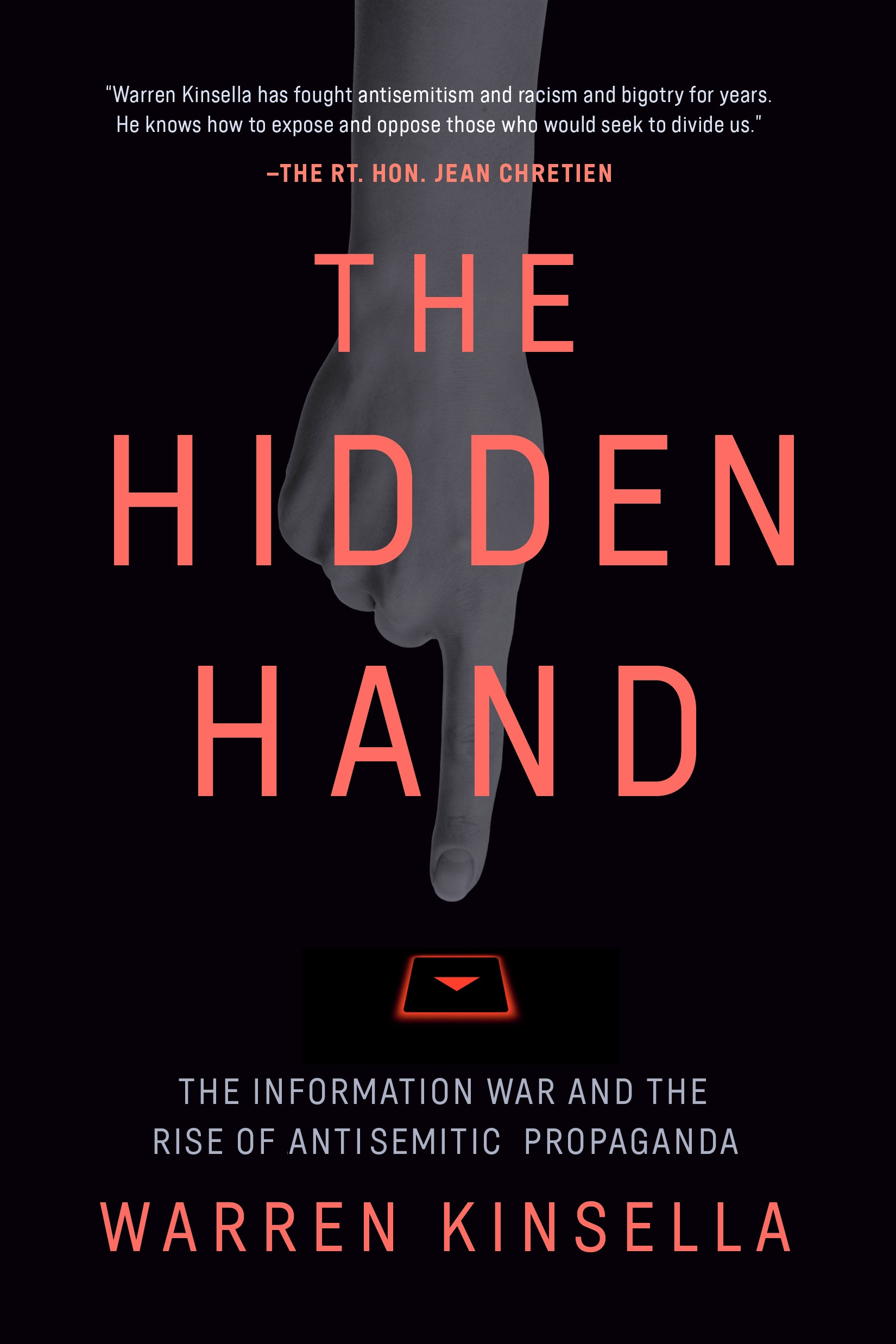
KVETCH and RELEASE with Jon Liedtke welcomes author of The Hidden Hand, Warren Kinsella
Warren Kinsella discusses his book, The Hidden Hand, exposing how post-October 7 anti-Israel protests were pre-planned, state-sponsored propaganda campaigns targeting Western youth. He highlights operational campus coordination with terror groups, sharply criticizing institutional appeasement and the University of Windsor’s total capitulation to illegal encampments, which endangers Jewish student safety worldwide.
Transcript (Gemini Generated):
Jon Liedtke: Welcome back to Kvetch and Release joining me right now is Warren Kinsella. Veteran political strategist, broadcaster, commentator, lawyer, and author, and director, but author of the explosive new book, The Hidden Hand: The Information War and the Rise of Anti-Semitic Propaganda. Warren, great to have you here. Thank you so much.
Warren Kinsella: Thank you for having me.
Jon Liedtke: You know your book confirms what many of us saw play out in real time, the explosion of unrest and anti-semitism, not just on Canadian streets, post October the 7th, but really across much of the Western world. And it wasn’t, as you’ve argued, not it wasn’t an organic grassroots social movement. It was an astro-turfed, highly disciplined, state-sponsored information campaign. And, you know, it’s it’s really interesting how you put it all together. So my first question for you, you know, you’ve been tracking hate groups for over three decades, going back to the Web of Hate in the 90s. You argue that the current global narrative though it didn’t shift after October the 7th, it was pre-positioned. Within weeks, as I mentioned, thousands of coordinated protests popped up, and it wasn’t even weeks. In some cases, that day, the next day. Um, and we saw uniform signage, identical talking points. How did this axis successfully hijack the Western narrative and pivot the conversation to settler colonialism before Israel even launched its counteroffensive?
Warren Kinsella: Well that is an excellent question that is the main question Jon, um, you know, so my background just very quickly is as you know, perhaps your listeners don’t know, is uh campaigns. And so I’ve been involved in uh election campaigns at a national level, provincial level, international level, you name it for years. Uh some of won, some of lost, but, you know, along the way one of the things that you uh learn working on a campaign is how to spot one. And so, um, you know, the uh uh the criteria for a campaign or the indications of a campaign is campaign leadership, and money, and volunteers, and uh messaging, and a social media presence, and a mainstream media presence, and you name it. And um, all of that was here. And by here I mean so October 7th was this terrible cataclysmic event for the Jewish people and then I would argue the world. 1200 men, women, children, and babies slaughtered, um, hundreds of people kidnapped and taken to Gaza. Um, Israeli women and girls sexually violated, and hundreds and hundreds of people grievously wounded. They often get forgotten. And, you know, you would expect that people would be sympathetic to uh the Jewish people at that point. And but in fact what happened was and and this was before Jon, ee- Israel had even responded. Before Israel had even organized itself enough to um hit back at Hamas militarily, you know, that happened in like the at the end of October. Before that even happened, before Israel had done anything, when it was the victim alone, 2500 protests around the world, same signs, same mess- like professionally made signs, same chants, same slogans, military precision. And so I spoke to political people I know and I just said, you know, this is a um [laughter] this is a campaign. And the people I spoke to on the left, the right, you name it, they all said, um, yeah, this is a campaign. And so that became the subject of my book, The Hidden Hand, and also uh the documentary that we have done uh under our company Daisy Documentaries, which we call The Campaign.
Jon Liedtke: So I want to talk about that operational timing because, you know, it’s not just strategic speculation anymore. And not to put aside the incredible speculation strategically that you were able to do and uncover through your investigation, it’s actually in federal court now. There’s a major lawsuit in New York launched by victims of October 7 attack that alleges that the Columbia University chapter of Students for Justice in Palestine had advanced knowledge of the attack itself. The justification for that allegation is that they have an Instagram account that was dormant for months and then it suddenly woke up the day before saying, “We are back,” exactly three minutes before, excuse me, the first rockets fired. When we look at when we look at your theses of a hidden hand, how deep does this operational coordination go between Western campus networks and foreign terror groups?
Warren Kinsella: Well they knew in advance. And what I can tell you based on my campaign experience again, not only do you acquire the ability to spot a campaign, you also know you cannot, Jon, you cannot set up—forget about an international campaign, you can’t set up a national campaign in a day. But as you pointed out, like SJP at Columbia had a so-called toolkit ready to go minute—while actually the attack was still under way in Israel. It was still happening, they were still occupying kibbutzim, they had still they were killing people in Sderot, which is a major city in Israel. Like they were active, and SJP and all these alphabet soup of anti-semitic groups were issuing so-called toolkits that had talking points in them, messages, “Here’s the media you contact,” they even had, “If you get arrested, here are the lawyers that will represent you for free.” And on the cover of SJP Columbia’s toolkit were motorized paragliders. And what is imp- and that was a slip by them because what it showed is that SJP, which is found in Canada and in the United States, Students for Justice in Palestine, knew in advance the attacks were going to take place. So my argument as I make in The Hidden Hand is they were complicit in it. So the answer to your question, this had been in the works for a long time. And, um, you know, I believe the government of Netanyahu um deserved some criticism for not being able to prevent this and have better intelligence. But anyway, that’s going to be dealt with by Israel on another day. The bottom line is they knew this was going to happen and they were ready for it.
Jon Liedtke: So there’s also a brutal psychological layer to this as well with that lawsuit. One of the freed hostages, Shlomi Zev testified that while he was held in Gaza for 250 days roughly, his Hamas captors bragged about having operatives on Ivy League campuses. They even showed him Al Jazeera photos of the Columbia encampments to try to break his spirits. So what does that say about the true nature of the Western protests when top-tier terrorist entities are using the protest themselves as psychological leverage against the hostages? And I don’t think that everyone at the protest knew in advance, um, or even knew that there were those who knew in advance. But what does it say about it more broadly?
Warren Kinsella: Well there was there was they had this binary approach. And to those of us in the West, it’s foreign to us. Number one, I think it’s arrogant of us to assume that our values are the values they want. They don’t. They object to our values. They would like to see a change in Western democracy and they’re prepared to use violence to advance it. But, you know, you’re quite right is that they um had a knowledge, they had an understanding of how people would react to their uh propaganda. So in this binary approach, for sure, they had horrible stuff. They were live streaming atrocities on social media platforms, and the social media platforms let them do that, and that was to reach new followers and radicalize those people. But also to terrify and um harm—it was psychological terrorism against those of in the West those of us in the West who were sympathetic to what had happened to Israel and opposed anti-semitism and racism. Why did it work with that latter group? It worked with that latter group because, you know, the Anti-Defamation League of the um which is one of the leading human rights organizations in North America had, Jon, for about 60 years been doing polling showing that if, you know, you were concerned about racism, you were also concerned about anti-semitism. So they moved in tandem. They moved together. And that was young, old, east, west, rich, poor. If you didn’t like racism, you didn’t like anti-semitism. Around the time of the pandemic, anti-semitism started to go like that among young people. So among Gen Z, 18 to 24, and among millennials from about 25 to 42. And when I say that they started to diverge from the notion that Israel deserves to defend itself, Israel deserves to exist within safe and secure borders, I’m talking they chose Hamas. For the first time in the history of polling in Canada and the United States and in Europe, Gen Z support Hamas over Israel. They believe that the atrocities committed on October 7th, about a quarter of them believe that the atrocities committed were justified, quote-unquote, “justified.” Some of them even believe that attacks on Jews here in North America are justified. They believe in conspiracy theories, they have disinterest in democratic institutions and in a functioning society, they some of them believe in Holocaust denial. Like we’re talking people who have moved away, young people who have moved away from societal norms and values. Why did that happen? The pandemic was a big part of that, you know. They were ripped off during the pandemic. We all know that. Um, job opportunities were lost, housing, the ability to like even to have a grad or a prom dance, they lost all of that for years. And it rendered their opinions on a lot of these issues very cynical and very angry, and waiting for them was Iran and Hamas and Hezbollah and their allies in Russia and China. And they took advantage of that opportunity and that’s why we now see so many young people online and in the streets um agitating against Jews and the Jewish state, but also Western democracy.
Jon Liedtke: It’s definitely concerning for the future when they end up taking up positions of power, and we can see Israel already deciding to sort of shift its alignment more domestic when it comes to uh they talk about, you know, weapons manufacturing, not being able to rely on the United States moving forward, but that’s a topic for another day. I want to shift gears though specifically to our Canadian streets. We’ve watched protest imagery evolve from expressions of solidarity into actual tactical intimidation. The inverted red Hamas triangle comes to mind specifically, a literal combat targeting indicator that was used to mark death on October the 7th. It’s being brandished openly at Canadian universities and on our streets to intimidate Jewish students and critics. Um, why are our institutional leaders treating a targeted threat of violence as protected speech?
Warren Kinsella: Ah, you got me um honestly, men, I don’t know. Um, have they made a crass consideration or calculation that, you know, there’s four times as many Muslim voters as there are Jewish voters in Canada? Maybe. Have um some of these anti-semitic themes permeated permeated progressive politics? For sure. We see that with the Democrats and the New Democrats and now increasingly in the Liberal Party. Like that’s part of it. Um, but I think that um in the main, it’s not all leaders. Um, you know, you have some leaders who are concerned and are acting to deal with this problem and they’re not Jewish, you know. They’re they believe that the Jewish people deserve to be protected and deserve equality. But you also have non-Jewish excuse me, non-Jewish like me who um just object to this because anti-semitism is wrong. You know, that’s how I was brought up by my parents. So I think that um why this is happening, there’s a multiple number of reasons for it. But it needs to change. You know, if the Prime Minister is giving a speech as he did a few weeks ago at Holy Blossom in Toronto saying that it is a a terrible problem, that it is against the the compact that Canadians have between each other, the relationship, the contract, if he means that, then he needs to do something about it. And, you know, I I think I’m just fed up with the thoughts and words stuff, Jon, um and hopes and dreams. Like in, you know, Montreal on Monday, um a guy traveled across the country to go to a predominantly Jewish neighborhood, where I was born by the way, um and target Jewish businesses, terrified Jewish citizens, um and a Jewish man, uh Michael Michel Misrachi lost his life. And the reporting of it, not at Postmedia where I write for, was, “Oh, it’s all about anti-feminism.” Well, it was part of that. “Oh, it’s all about Pornhub.” And, yeah, it was part of that. But he talks about killing Zionists in his manifesto. It’s right there in black and white. But you’re damned if you can find any mention of that on CBC or the Toronto Star or the Globe and Mail. They just didn’t mention it. And it’s like when stuff like that is happening, you can almost understand why leaders think they can get away with being uh disinterested in the problem. They say, “Okay, well, you know, the media is not writing about it, so why should I stick my neck out?” So there’s a lot of blame to go around here and it’s not just our politicians, it’s a number of institutions in our society.
Jon Liedtke: You know, one of the worst things that I saw on Monday, and still continuing today this week, um is journalists who have been actively trying to explain to Jews on Twitter, “No, no, no, it wasn’t about Zionists. Let me explain to you why it was actually about these other groups.” So it’s not just the omission, there’s actually active gaslighting occurring right now, and I I won’t name some names right now. But let’s bring this to my backyard here in Windsor. While most of the universities eventually looked to the courts or to trespass laws to manage with their encampments that were illegal, of course, the University of Windsor’s administration opted for total, unconditional capitulation. They signed a sweeping MOU to dismantle the camp that included pretty well all of their demands. Uh, the deal was with the encampment organizer was bragged as the most comprehensive in North America is what the members say. Now legal experts like Michael Geist blasted it as a textbook example of an institution abandoning its neutrality standards. So when a Canadian university does surrender academic freedom and compromises its own equity policies just to satisfy an unsanctioned group that doesn’t represent the student body and may or may not even be comprised majority of students, does this set a dangerous precedent for higher education across the country?
Warren Kinsella: Yeah, it does. And it’s a disaster for Windsor. Windsor’s got a big problem. And it’s not just at the university. The university, as you pointed out, gaslit Jewish students and made the campus an unsafe place for them. Now I know there are people like Dwight Duncan, uh former Minister of Finance for the government of Ontario, who’s trying to deal with that. Dwight is a good man and he’s reaching out to a number of people to fix that. And there’s people at the university trying to fix that. But you’ve got a mosque, Jon, in in Windsor that is more or less openly allied with Hezbollah. And, you know, so why is this happened, why is it such a problem in Windsor? I think it’s a bit of geography. You’ve got just right on the other side, Detroit, and in Michigan and in Dearborn, you’ve got places on the other side of the border that have become radicalized and have embraced more or less openly anti-semitism and extremism. And I think some of it is leached across the border into institutions like the university um in Windsor. You have got a big, big problem there that needs to be fixed because it ultimately it won’t just destabilize uh institutions for Jewish Canadians, it’s going to destabilize a lot of institutions in the city of Windsor.
Jon Liedtke: So I know that you’ve got a really busy day, so I want to wrap things up with one last question here. In the epilogue you lay out and I don’t mean to give it away, but, you know, a 10-point road map about how people can fight back, um and some of the tips include ending digital anonymity, penalizing platform algorithms, closing uh charity loopholes that we have. If you were sitting across from the federal public safety minister right now and they were going to actually take your advice, what is the single most urgent non-negotiable policy change that needs to be executed to stop the bleed that we have right now? If Canadian leaders continue to choose appeasement and administrative cowardice over action, I mean, what would you say would things look like 5 to 10 years down the road to the minister?
Warren Kinsella: One of the things that these people have done, it’s a propaganda campaign. So they’re like cults. And what is critical for any propaganda campaign is language, the manipulation of words and images. And these guys have done this really successfully, you know, with the red triangle as you pointed out. The red triangle, which you see all over the place at these encampments and protests, it’s it is a symbol saying, “Kill this person.” That’s what it means. Like it’s even worse than a swastika. And so they’re permitting that to be circulated in Canadian society. But also the words. And in Germany and in other countries, under allies we’ve got, you know, you’re not allowed to say, “From the river to the sea, Palestine will be free,” because it’s it’s recognized that that is a euphemism for genocide of the people of Israel, the Jewish people, you know. And uh Intifada, globalize the Intifada. The Intifada was a more deadly period, the second Intifada was more deadly for the Jewish people, the Israeli people, than October 7th was. 1400 people were killed in the second Intifada and then you have all these little jerks going around saying, “Globalize the Intifada.” And it’s like well you’re saying that Jews should be killed. So that’s what I would say to lawmakers is you need to fix that, right? That’s one thing you can do right now. Other stuff we can talk about, changing immigration policy, uh eliminating anonymity, you know, the wearing of masks, all that. But just some of the words and images that are now everywhere in Canadian society, that needs to stop. That’s something they can do right now.
Jon Liedtke: Warren Kinsella, I want to thank you so much for your time. I really do appreciate it. Author of The Hidden Hand um and director of the upcoming The Campaign. Can’t wait to see that myself once it makes its way onto streaming platforms or you get down to Windsor, Ontario. But again, appreciate your time, I appreciate everything that you do uh for being, you know, a non-Jewish ally to the Jewish community. It means a lot to me personally um and then just as someone who cares about this country. Thank you so much.
Warren Kinsella: Thank you, my friend. Thanks for having me on.
Jon Liedtke: You have a great day. Thank you.
This can be heard on Spreaker, Spotify, iHeartRadio, Amazon Music, or other podcasting platforms.
Kvetch with Jon Liedtke is a podcast of all of my radio interviews, reporting, commentary, media interviews, and more!
I’m bored of culture war theatrics. If you’re interested in more deep dives into the absurd, funny, politically intriguing, or just downright batshit wild stuff that happens all around us, be sure to subscribe and follow me on my socials. Let’s talk about this vast country we live in and the politics which makes it operate. Email me at high@jonliedtke.ca
Leave a Reply