
Jon Liedtke joins 610 CKTB’s Gene Valaitis for his weekly segment, Liedtke Has a Take!
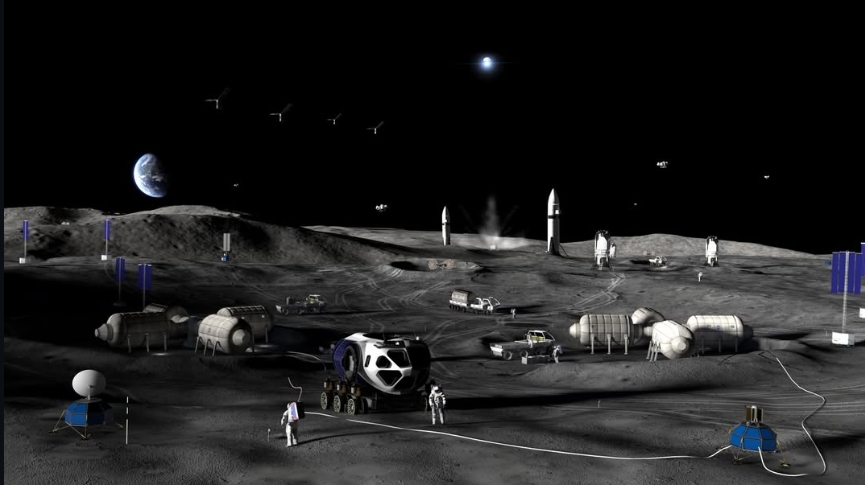
Liedtke argues that outsourcing space exploration to billionaires risks replacing democracy with corporate autocracy and digital feudalism. Mega-corporations controlling life support will dominate lunar bases. Over time, future generations born on the Moon will naturally sever ties with Earth, sparking an asymmetric conflict for independence from Earth’s political governance. He also draws a parallel with Hiram Walker’s corporate whiskey town, Walkerville, in what is now Windsor Ontario.
Transcript (Gemini Generated):
Gene Valaitis: Liedtke’s got a take. John Liedtke joins me this morning. And good morning, John.
Jon Liedtke: Good morning, Gene.
Gene Valaitis: Okay, so the USA has announced plans for a permanent moon base in a relatively short time. Now, I’m kind of excited about this. Now, you argue that because NASA’s public budget is always an easy target for political hacks, we’ve essentially handed over the final frontier to private companies. Now, is outsourcing space exploration to billionaires, and in Musk’s case, trillionaires, is that a brilliant shortcut or are we sleepwalking into a big mistake?
Jon Liedtke: You know, I love this one too, Gene. We’ve got self-driving cars, we’ve got flying cars, we’re talking about moon bases now and getting to Mars after that. We are living the Jetsons. But we are sleepwalking right off of a cliff. NASA’s budget is a political football because the average tax-paying citizen usually is staring at their grocery bills or their gas bills and they don’t see what the immediate return is on a lunar rover. Even though it was General Motors that did much of the work on in what, the 70s on the first one, and I’m sure that contributed to their bottom line and a lot of shareholders seeing good. But here enter Elon and Bezos, and they’re not bogged down by governmental risk-allergic bureaucrats paralyzed. They have liquidity, they have speed, and they’ve got massive egos, and they’re building very, very big phallic things and I think, you know, they like the idea of that. But the profit motive will definitely get us out of low Earth orbit faster, but we’re trading accountability for corporate autocracy. Boardrooms are going to be deciding whether or not they want to militarize their lunar base under the guise of protecting their assets. That is how we get a step closer to a weaponized Mars. We are cutting corners on the timeline, of course, but we’re selling out democratic souls to do that.
Gene Valaitis: Yeah. Um, whenever we get one of your takes, you always have fascinating, fascinating takes. Now, you drew a fascinating line between the future of deep space and your local history with the Hiram Walker’s corporate whiskey town near Windsor. Explain that one.
Jon Liedtke: You know, listen, we’re going to be allowing these private companies to go up onto the moon, onto Mars and build their own neighborhoods, corporate towns, if you will, and Walkerville is the ultimate historical blueprint for that. He was the benevolent corporate town. So in my backyard, he built a beautiful paternalistic corporate fiefdom. He paved the streets, he built the schools, he controlled his own police, but eventually geography took over and Greater Windsor swallowed Walkerville up in, I believe, ’35. But space won’t work that way. There won’t be natural urban sprawl in a vacuum. Incorporation on the moon will happen exclusively through hostile corporate takeovers or aggressive geopolitical annexations by superpowers who are able to. This won’t be the benevolent distillery boss giving you a public park, this will be a mega-corp where breathing will be an itemized line on your monthly bill, and if you cross management or if you try to unionize on the moon, they can remotely lock your habitat door from an office in Austin or Seattle.
Gene Valaitis: Yeah. Well, we already see that Elon Musk is controlling the majority of active Earth satellites with Starlink, effectively making his infrastructure too big to fail for modern governments. But what happens to the balance of power when a few private boardrooms own the literal oxygen, communication network, and power grids on the lunar surface, especially when Russia and China want to get theirs as well?
Jon Liedtke: Yeah, no kidding, right? The balance of power doesn’t just flip, it will completely vanish. As you said, Musk already has put up more satellites into space than all of humanity in history combined, um, and if a government tries to over-regulate him on Earth, they’ll risk crippling their own communication networks or global internet infrastructure. I mean, he is already a sovereign entity in all but a name. Uh, but translate that to a hostile lunar environment, when a private boardroom controls the oxygen scrubbers, the water recycling, the power grids, the comms, they don’t need a standing army to dictate the law. They don’t even need to fire a single shot. They can throttle the data bandwidth, they can dial down the oxygen, they can turn off your water if you violate the terms of service on a contract. So we aren’t pioneering the future, we are blindly walking very quickly right back into feudalism but with a digital spin.
Gene Valaitis: Yeah, I like how you’re looking way, way, way down the road. Now, you anticipate a looming crisis once the first generation of native moon people are born with zero physical or emotional ties to Earth. That’s interesting. What do you think will happen?
Jon Liedtke: Well, you know, uh, this is the problem, right? When these people who are born up there, the first generation of ones who have no ties whatsoever, they will only know their homes. And if people try to take their homes away from them, history has proven that people will fight for their homes, full stop. The first generations born on the moon won’t care about Earth or the ties to it that their family might have had before them. To them, the planet Earth will just be a heavy blue ball in the sky filled with politicians demanding resource shipments and taxing their labor, and, you know, they’ll say ‘this is taxation without representation,’ and we saw what happened with that a couple hundred years ago. But culturally and emotionally, the tie will be completely severed. Biologically, they’ll be developing in one-sixth gravity, meaning their entire bodies will be adapted to the moon, not to Earth. So coming to the Earth wouldn’t even be a vacation, that would be a physically crushing, agonizing medical nightmare. So when some bureaucratic committee in Ottawa or Washington tries to pass legislation to govern a population 250,000 miles away, those moon citizens are going to look up to Earth and say ‘you don’t breathe our air, you don’t walk on our ground, you don’t rule us.’ This is a mathematical certainty.
Gene Valaitis: So what happens when, I can’t believe I’m saying this, what happens when the moon decides to take on Earth?
Jon Liedtke: This is what gets really scary. This ends in a brutal Cold War-style diplomatic stalemate. I mean, Earth can’t capitulate if the moon decides to push back by any means whatsoever. Uh, if governments allow space colonies to unilaterally secede and hijack supply chains, well then the entire framework of international law on Earth will collapse. So this war will be entirely asymmetric. Earth will try to exert pressure by freezing bank accounts and trying to do things on Earth to the corporations, and then the moon colony could retaliate by trying to just drop giant boulders onto Earth, for example, and gravity will do the work. But at the end of the day, it’ll end in a diplomatic resolution like most conflicts do, but what the outcome of that diplomacy looks like, that’s where things get interesting.
Gene Valaitis: All right. Well, it’s going to be a fun time. I don’t know if you and I are going to be around for Moon versus Earth, but I hope so, Jon.
Jon Liedtke: Well, yeah, I hope so too. But this, this moon base could be happening in a relatively short time. Great take this morning.
Gene Valaitis: Thank you, Gene. Have a great one.
Jon Liedtke: All right. There he goes. Jon Liedtke. Liedtke’s got a take.
This aired on 610 CKTB
Follow Gene on Twitter or LinkedIn
Leave a Reply