
610 CKTB’s Gene Valaitis and KVETCH and RELEASE’s Jon Liedtke discuss the Ticketmaster-Live Nation monopoly, highlighting the shift from physical ticket ownership to “digital serfdom”. Liedtke critique skyrocketing prices—far outpacing inflation—and high service fees, exploring U.S. antitrust lawsuits, and his proposal for the Royal Canadian Mint to print secure physical tickets.
Transcript (Gemini Generated):
Gene Valaitis: It’s Gene Valaitis on 610 CKTB, Niagara’s News and Talk. All right, our pal Jon Liedtke is back, and of course, he writes for Kavetch and Release. Just love that title. Good morning, Jon.
Jon Liedtke: Morning, Gene.
Gene Valaitis: Hey, listen, you’re calling and we’re talking about Ticketmaster here and Live Nation and everything that has gone on in the U.S. The Attorneys General of many states in America are trying to break up that company. Now, you’re calling for a total overhaul of how we buy our own culture, in other words, tickets and stuff like that. So, are we really just serfs in the Ticketmaster digital kingdom? I guess we could say because if you look at the facts and the figures, if you go back to, say, 1975, my first year in university, the Stones played Toronto, tickets were $7. And $7, yeah. Now, inflation says then they should be $45 today, but they’re way more than $350, $400, $500. What happened?
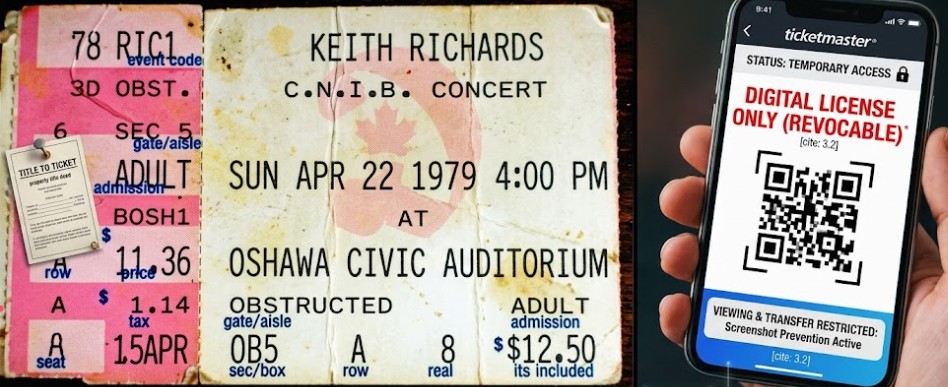
Jon Liedtke: Yeah, you know, Gene, it is wild. We’re not just serfs; we’re digital sharecroppers. In the ’70s, you bought a ticket, you put it in your pocket, and it was your physical property. You owned that. Today, you’re paying a 45% vig for the privilege of a temporary digital license that can be revoked, refreshed, or restricted at a moment’s notice. We’ve traded sovereignty for rotating QR codes. We pay through the nose for the leash. It’s not evolution; it’s a high-tech enclosure of the commons. But, you know, my mom saw—it was Keith Richards at the time, sorry, when I did the setup, I was a little bit off, I did a bit more research on it. Keith Richards got arrested for heroin possession in Canada, he had to do a benefit concert for the blind, so it wasn’t a Stones show, it was a Keith Richards show and it was in Oshawa. But it was a $10 ticket she got to sit on stage for. So I mean, that would be $45 today, but it’s $350 for nosebleeds. So look at the app right now. You can barely get in the door for those hundreds. And if our grocery bills rose that much, a liter of milk would be costing $45 today. That’s systemic wealth extraction. It’s not inflation.
Gene Valaitis: Yeah. Well, when that trial was ongoing in the U.S., they released some Slack messages of senior executives bragging about how, quote, “we’re robbing the fans blind.” So I don’t know if that was narcissism or if it was a confession or if it was just bragging.
Jon Liedtke: You know, Gene, there’s a great scene in the movie The Big Short about the subprime mortgage crisis, and they’re doing investigations into how the whole housing market crashed. And a couple of realtors are, you know, talking about how they’re ripping off immigrants and newcomers to the country. And the investigators go, “Why are they confessing?” And they go, “They’re not confessing. They’re bragging.” So that is the problem. It’s the same thing here. They’re calling their customers stupid. The mask hasn’t slipped off; it’s incinerated. This is a mob-style operation with a Silicon Valley paint job, some could say. They’re not providing a service; it’s more like a protection racket where they charge you the fee to protect you from the very scalpers that they host in the back room of the venue. This is—it’s all just disguised as a user experience wrapped up as Goodfellas.
Gene Valaitis: Well, speaking of user experience, I think anybody who’s ever attended a concert or has attempted to attend a concert has gone through the “I’m online, it’s 9:59 and 30 seconds, 20 seconds, 10 o’clock! Grab your credit card. Yes, I want the—” Sold out. Everything. And then lo and behold, you go onto one of those secondary seller markets and the tickets you wanted to buy for 300 bucks are now 3,000 bucks. Now, Doug Ford had an anti-scalper law and they got rid of it. Now it was brought back in last year. So Ontario has 32 investigators on a World Cup enforcement blitz. So is this—is that a real crackdown or just political theater?
Jon Liedtke: I want to believe it’s real, Gene, but this does reek of theatrical performative optics. Just look at the quiet hands, right? The government is always happy to play the hero, but they’re also a silent partner because they pocket the HST on every single one of these hyper-inflated tickets. So it’s not in their bottom line to actually be the good guy. It’s hard to be the sheriff when you’re collecting a cut of the heist. If they want to prove it’s not theater, they need to drop the hammer on these monopolistic platforms, not just some guy in a basement in Welland trying to pay his rent.
Gene Valaitis: Now, I found this interesting. You say we don’t own our tickets anymore. So—I mean, what are the dangers of things like rotating QR codes, etc.? You call them a digital leash. I don’t quite get that. What’s that mean?
Jon Liedtke: Well, they tell you that this is for security, but it’s really about custody and control. Custody over the ticket and control over the user. If you can’t take a screenshot of your ticket, if you can’t really print it out in a meaningful way that you can use, and you can’t hand it to your neighbor without using their proprietary application, do you really truly own it? But I mean, listen, we live in a country—most countries, you don’t own your passports, so should we own our tickets? This is the real question about things. And I like the idea of still owning the products that we have. I don’t like when I buy a movie off of Amazon or I download a game off of Steam, but I don’t really own it; they can get rid of it. You’re just renting a seat of land, a digital piece of land by a California monopoly. We’ve outsourced cultural property rights to servers in the U.S. and we pay the interest for the convenience of being electronically shackled. So it is a leash.
Gene Valaitis: Yeah, yeah. Just as an aside, you know, most people don’t know that, but no, you do not own your passport. The government owns your passport even though it’s got your name and photo on it. So that’s so true. Just aside fact there.
Jon Liedtke: Yeah.
Gene Valaitis: Okay, so in the U.S., after that big trial, as I said, 33 U.S. states are moving to break up the company. Again, U.S., the U.S., U.S. What’s that mean for us here in the Niagara region?
Jon Liedtke: Well, the ideal outcome is a total forensic breakup after an auditing. We need to separate the promoter from the ticket seller from the venue so they all have to actually compete for our business again. When I owned Higher Limits Cannabis Lounge, I had the venue, but I would also have promoters that would bring in the shows, and then I went to a third-party ticket seller, a local one who did that. So it was a three-part model where the competition made it cheaper for the end user. But I want a future where a kid in Niagara can go see a show without their parents having to take out a second mortgage, Gene. We need to stop treating concerts like they’re an asset class and start treating them like they are our culture again. I mean, I just saw the CRTC has taken 25 points off of digital streaming platforms, and I get that this isn’t their direct mandate, but I mean, what are we actually trying to do here right now? So if the World Cup is the line in the sand, let’s draw it deep and let’s stop that bleed.
Gene Valaitis: Mm-hmm. Now this is fascinating, and only you would have this take, but I’m always interested in what you have to say. You want the Canadian Mint to print concert tickets. You know, there’s a little thing when we come back from commercials, the woman says, “Gene Valaitis: brilliant or crazy? You make up your mind.” I don’t know, is this a brilliant or crazy move on your behalf?
Jon Liedtke: Crazy like a fox, Gene. Look, if the Royal Canadian Mint can produce the most secure, unhackable polymer currency on the planet—stuff that we sell to other countries quite frankly—why do we let a tech giant tell us they need an app and that printing things don’t work? So we should have a Made in Canada digital bill of rights, a return to physical sovereignty. We can print World Cup tickets at the Mint. They can just print tickets and put the logo of whatever the official, you know, partner is for it. Make them physical, make them secure, make the tickets ours again. If you can hold it, you can own it. That’s how we kill the bots that the Ticketmasters scream about. That’s how we kill the data mining all in one shot. We reclaim our data, we keep it in Canada, we end this Silicon Valley shakedown. I mean, if we want fairness and transparency and the right to actually own things we pay for, we’re going to have to fight for it. And it—yes, you know, it’s a hair-brained scheme to use the Mint, but if it can start a conversation about actually getting our rights back as ticket holders, I think that’s a good thing. And let’s be honest, the size of these venues and the size of these performers and the size of these organizations are outside the scope of us. When you have concertgoers at a Taylor Swift concert, a bunch of teenage girls literally causing the Richter scale to change because they’re moving so much in California that it’s showing up seismologically as earthquakes—like, this is outside of our control. So there is a need for excessive regulation here, in my opinion.
Gene Valaitis: Well, we’re going to see what happens. And you know, as a young kid working on a rock radio station, it was always like, “You know, what a rip-off, I can’t get tickets.” And you know, now it’s like 40 years later and I’m still talking about tickets and what a rip-off. So hopefully we’ll get this thing under control.
Jon Liedtke: Hey, maybe next 40 years, Gene.
Gene Valaitis: Yeah, there you go. I’ll still be here. Great job this morning, Jon. And I know we’re talking to you tomorrow again. Have a good day, okay buddy?
Jon Liedtke: You too. Cheers.
Gene Valaitis: Jon Liedtke. You just never know what he’s going to say.
This can be heard on Spreaker, Spotify, iHeartRadio, Amazon Music, or other podcasting platforms.
Kvetch with Jon Liedtke is a podcast of all of my radio interviews, reporting, commentary, media interviews, and more!
I’m bored of culture war theatrics. If you’re interested in more deep dives into the absurd, funny, politically intriguing, or just downright batshit wild stuff that happens all around us, be sure to subscribe and follow me on my socials. Let’s talk about this vast country we live in and the politics which makes it operate. Email me at high@jonliedtke.ca
Leave a Reply