
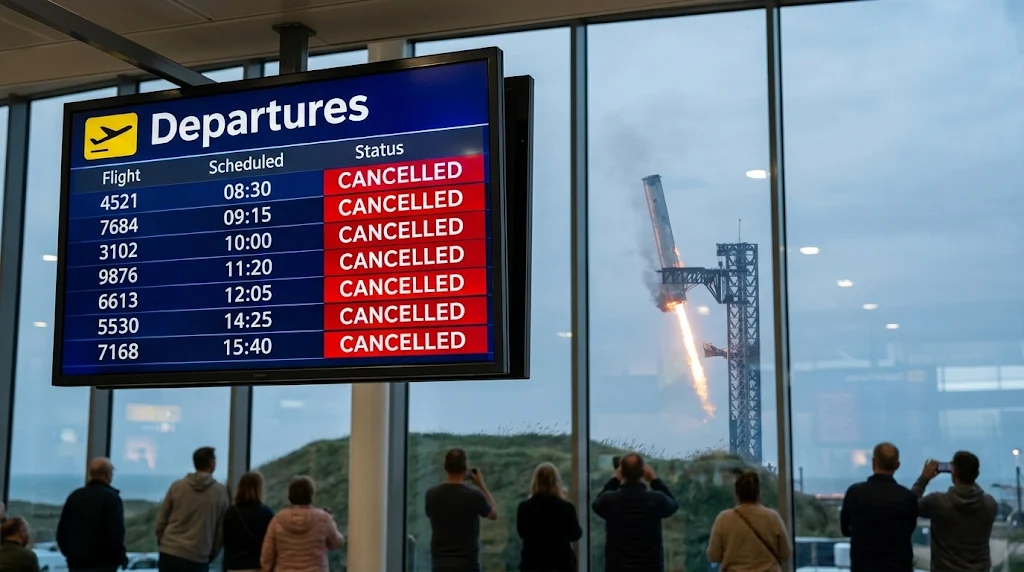
Jon Liedtke dissects the United States’ FAA airspace shutdown, contrasting Washington’s 1980s copper-wire gridlock with NAV CANADA’s modernized fiber network and SpaceX’s mid-air Starship catch. He examines stranded Canadian travelers, geopolitical vulnerabilities, and why government must maintain basic infrastructure while private enterprise drives breakthrough innovation.
Liedtke’s Got a Take! is on 610 CKTB’s Gene Valaitis Show every Monday, Tuesday, Thursday, & Friday morning!
Transcript (Gemini Generated):
GENE VALAITIS: It is time for the Monday edition of Liedtke’s Got a Take with Jon Liedtke. Good morning.
JON LIEDTKE: Good morning, Gene.
GENE VALAITIS: Man, I am still freaked out about what happened last Friday because airports in the United States are still not back to normal. And of course we’re talking about back on Friday, the U.S. Federal Aviation Administration shut down American airspace for over four hours due to allegedly a copper wire glitch, a router glitch. Man, it sounds like my Saturday when the computer goes down—it’s just ridiculous.
Uh, but you know what, there’s a great comparison which you pointed out to me over the weekend, and I want to hear more from you about this. It’s taking a look at how government-run services operate and react versus what the private sector does. So let me start with the basics before we get into politics: what actually really broke down in U.S. airspace back on Friday afternoon, and how did that glitch there hammer not just Canadian travellers all weekend, but travellers right around the world? A wire, copper—come on.
JON LIEDTKE: “I hate to blame anybody, Gene, but the Biden administration hooked up a lot of copper into glass. Copper, if you know anything about electrical engineering, you cannot hook up copper into glass, so a lot of money was wasted. Essentially what you saw was very old equipment had a heart attack. We essentially want to blow it up and put new in. And we can do it simultaneously with very little trouble, so that’s what we’re doing, but we need the funding.”
I didn’t say that—the President of the United States said that. So it’s an issue of copper being hooked up to glass by the Biden administration, which of course sounds like nonsense. But if you actually do look into it, there is a fact that’s based there. And it’s that U.S. air travel is literally held together with 1980s copper wire and pretty well duct tape. And if Washington breaks your flight, what we found here for Canadians is that you’re left holding the bill in Canada with zero compensation from the airlines.
GENE VALAITIS: Yeah, that’s true. You know, Trump is on his way to China—he’ll be meeting with Putin, Chinese leader, maybe he’ll bump into Mark Carney, who knows. Uh, but you know what, the Chinese and Russians—I’ve said this a couple of times this morning—they must just be laughing at the United States. I mean, they just revealed its vulnerability of commercial aviation in the United States. And where was Trump? He was hiding. And his first tweet out on Sunday morning was about a golf course he didn’t like and making movies in the United States.
And look at our own backyard: right across the river from the Detroit Metro Airport, Windsor Airport ran right on schedule, and NAV CANADA never glitched once. So why was the Canadian system completely fine while the U.S. was froze for nearly five hours and nobody was communicating with the people?
JON LIEDTKE: You’re absolutely right, Gene—our adversaries, the U.S.’s adversaries, have to be laughing at this. You know, missiles are really expensive to procure, to build; cyber hacks less expensive, but still cost money. Sitting back and not paying any money while your adversary inflicts this damage upon themselves—that’s free. That’s priceless, I believe is the Mastercard saying.
But here’s the big difference between NAV CANADA and the United States. Their government funds the Federal Aviation Administration directly from government, and as such it is subject to the whims of politics. Whereas NAV CANADA isn’t funded by our government. It’s funded entirely from user fees from the airlines themselves—so there’s a ticket fee that we pay—and then from public debt that they take on.
And 25 years ago, when the United States started to look at upgrading their copper lines to fiber optics—and they still haven’t finished yet, from 25 years—we were able to do it in 18 months in totality. Now mind you, Canada has a very different aviation grid than the United States—not as complicated, not as many airports. But you know, the fact of the matter is, when you don’t have to worry about governmental politics, it’s a completely different system. So I mean, it’s a smarter system, I think, and it works well too, because you don’t want to allow for your infrastructure to not see the investment that it needs on a regular basis.
GENE VALAITIS: Yeah. You know what got to me was listening to everything over the weekend, uh, but at the same time Elon Musk had one of his SpaceX rockets grabbed by this thing that looked like chopsticks and brought it safely back to Earth. Meanwhile, government aviation—they’re still blaming it on a copper wire, Jon.
JON LIEDTKE: Yeah, you know, it is absolutely astounding here. And when you look at this big picture, this weekend was really a split-screen of multiple events that were occurring. First, there was the nationwide ground stop that affected Canada as well. And then SpaceX Starship orbited the Earth 14 times, deployed 26 satellites, re-entered the atmosphere only to be captured by two giant mechanical steel chopsticks attached to the launch tower itself. Absolutely incredible—the first time an organization in human history caught an orbital spaceship out of thin air.
But then that was only supplanted yesterday by the legacy joint venture between Boeing and Lockheed Martin. They suffered their first outright mission failure in 20 years. They lost their rocket, they lost 40 of Jeff Bezos’s Amazon internet rival to Starlink satellites 10 minutes after liftoff, leaving Amazon now reliant on SpaceX to get its competition to the internet up into orbit—oy vey.
But here’s the thing, though: private companies get to blow up prototypes. They get to catch their rockets with steel chopsticks if it works. But the government’s job is to maintain the basics so the sky doesn’t fall. And what we found from this past 48-hour, 72-hour whiplash has been that the future is here, Gene. And whether you maintain the basics like NAV CANADA, or you ground the entire country because someone plugged in a router at 3 o’clock on a Friday afternoon causing the whole system to be overwhelmed with a maintenance update—what we have found is that at the end of the day, your choices are copper wire or giant steel chopsticks, public or private. One does better, the other one does better. We have to choose which one we want, though, to be able to advance our infrastructure needs, our societal goals. And I always say, when it comes to the public sector, their job should be regulation and oversight, and then let the private business be innovation and execution.
GENE VALAITIS: Absolutely. Great take on this this morning, and I still don’t buy the copper wire story, but then I like a good conspiracy theory in the morning.
JON LIEDTKE: What’s not to love about a conspiracy theory? We get to chat—otherwise we wouldn’t be doing this.
GENE VALAITIS: You got it. Okay, my friend, we’ll talk to you 9:45 Tuesday morning.
JON LIEDTKE: Looking forward to it.
GENE VALAITIS: Liedtke’s Got a Take.
This aired on 610 CKTB
Leave a Reply