
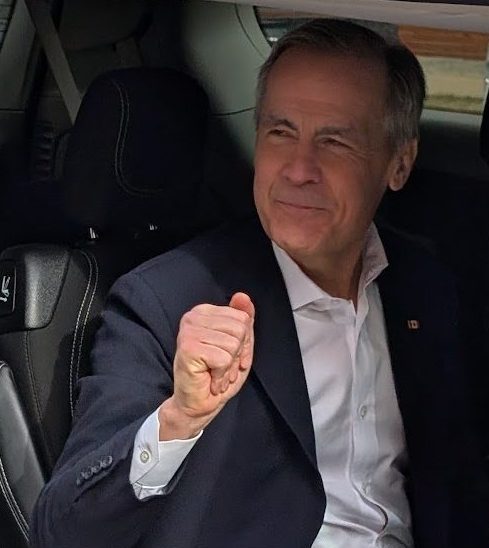
610 CKTB Host Gene Valaitis and guest Jon Liedtke discuss Mark Carney’s shift toward a “corporate” style of governance to counter U.S. protectionism. Liedtke views Carney as a “Chief Risk Officer” performing a forensic audit of Canada. Success is vital; failure could lead to the Liberal Party’s demise and a national structural free-fall.
Transcript (Gemini Generated):
This is a word-for-word transcription of the discussion between host Gene Valaitis and guest Jon Liedtke regarding Mark Carney’s role in Canada and current political dynamics.
Gene Valaitis: We’re talking about the Prime Minister’s recorded message to Canada that he delivered over the weekend and we played here yesterday. You know, with Katy Perry’s boyfriend, we’ve seen sunny ways, we’ve seen the selfies. However, my next guest—you know him, you love him—he says that era is dead and buried. He calls the new Prime Minister the Chief Risk Officer of Canada. Jon Liedtke from the Kvetsh and Release blog is with me now. Good morning, Jon.
Jon Liedtke: Good morning, Gene.
Gene Valaitis: So you wrote this piece basically saying Canada has stopped being a country and has started being a corporation under Mark Carney. So, is it a government or a hostile takeover?
Jon Liedtke: Um, you know, it’s—I wouldn’t say it’s a hostile takeover, but it’s a government that’s being operated in a very different way due to the realities that we’re dealing with right now. It’s a different universe than the one that we lived with under Justin Trudeau and feel-good politics into COVID, supply chains… now we’re dealing with Trump shakedowns. So, the fact that we’ve got a banker with the accountant urgency of coming in to go through things line by line, I think is actually really useful right now to have things looked at as a corporation.
Gene Valaitis: You said we traded a community organizer for a boardroom banker because we realized we’re in a mobster shakedown. That’s a pretty heavy-duty metaphor, Jon.
Jon Liedtke: Well, I mean, it’s true. The second Trump term right now is not going well, and it’s not due to policy shifts; this is a continental shakedown. We spent years with our guardrails down playing that feel-good politics. The global economy churned, but it turned into a back-alley scrap. Sunny ways is dead, it’s buried, it’s behind us, and we don’t need a cheerleader right now to make us feel good; we need that Chief Risk Officer—the CRO. Someone with a backbone who can manage the barbarians that are really at the gate right now with clinical accountant urgency. The vision isn’t lofty ideals, Gene; we’re talking about making sure the country is still solvent at Monday’s opening bell.
Gene Valaitis: You know, you mentioned this “forward guidance” video was an audience for one, and that was Donald Trump. Do you honestly think a guy who prides himself on supposedly “The Art of the Deal” is going to be intimidated by a central banker’s spreadsheet?
Jon Liedtke: No, definitely not. And it’s probably bringing a calculator to a knife fight to a certain extent. But it’s also bringing a diversified portfolio to a negotiation with a vulture speculator, and that’s something that Trump does understand. The video wasn’t an academic lecture; it was a high-stakes bluff. Trump respects leverage, he respects winners, and Carney is showing Mar-a-Lago and the White House that Canada is not a cornered animal anymore. We’re willing to play ball, but we’re also willing to walk away from the table. He’s signaling that he knows what the value of the assets that we have are. He’s willing to walk away. He’s not intimidated by the “Art of the Deal” theater. He’s showing Trump first-hand that if he tries to squeeze us, he’s squeezing a guy who knows where the exits are.
Gene Valaitis: Are we bringing a calculator to a knife fight?
Jon Liedtke: You know, maybe a little bit. It could be. I mean, I’m hedging back and forth on this idea. Sometimes calculators can be pretty powerful, though.
Gene Valaitis: In your Kvetsh and Release article here, you use this phrase—I’m not sure what it means—”regulatory red wedding” regarding the right. Pierre Poilievre and the Tories are calling Carney an “unelected elite.” Are they right or wrong?
Jon Liedtke: The “unelected elite” line—that’s just political fan fiction. They’re throwing spaghetti at the wall and it is sliding off. They’re trying to paint a working-class guy who rose up to run two of the world’s most powerful central banks as some kind of a scion. That worked on Trudeau because of the pedigree; it fails on Carney because of his performance. While Poilievre recycles the populist tropes that maybe started to work a couple of years ago but then started to falter, Carney is deconstructing the ledger with a magnifying glass. He’s not playing these partisan games; he’s conducting a forensic audit of the country, our trade alliances, and where we need to go. The noise of the peanut gallery is not going to change the math, Gene.
Gene Valaitis: You bring up this interesting comparison: the shareholder versus the citizen. Now, you wrote that it’s refreshing to be spoken to as a shareholder rather than, I guess we can say, a subject. But you know what? If you’re a shareholder, you don’t care about cash flow, you do care about debt, but what you really want to see is a dividend. So how does this Prime Minister produce a dividend for Canadians?
Jon Liedtke: Yeah, this is the hundred-billion-dollar question—multi-hundred-billion-dollar question. For my generation specifically—the tired, priced out, pissed off, quite frankly—being treated like a shareholder, though, is actually a promotion from being treated like a subject. We’ve got a leader who is, you know, telling us, “Hey, the ship’s taking on water,” instead of blowing smoke up our you-know-where. The risk? Yeah, it’s massive. If this restructuring only saves the C-suite executive class who gets to jet-set to the country club when it all falls apart, my generation’s going to be holding an empty bag. The corporation won’t just fall; it’s going to burn. But if the dividends don’t actually meet the people who can’t afford rent or groceries or gas right now, that hostile takeover won’t be coming from America and Trump; that’ll be coming from within.
Gene Valaitis: You know, two of the biggest trading areas in the country, not just Ontario: the Detroit-Windsor border and the Ontario-Niagara Falls-New York State border. You’re suggesting that Carney is basically building a shield for the rest of the world against the U.S. So how does this play out here? How does it play out Windsor-Detroit? Can we really afford to be the world’s shield when we’re so integrated with America? Regardless of what Carney said over the weekend—Trump bad, Trump bad, USA bad—they remain our biggest trading partner, period.
Jon Liedtke: And listen, I agree and disagree with your last guest, former PC leader Tim Hudak there. So we gotta be real about this. We’re not going to decouple from the U.S. just like we can’t decouple from our lungs or our heart. Windsor can’t decouple from Detroit. These are non-starters; we’re so integrated. We are the canary in the trade coal mine down here at the end of the 401. By turning Canada, though, into the “HMCS Middle Powers”—which is what Carney is doing—he’s building a diplomatic shield. We’re becoming the safe harbor for every other country terrified of U.S. protectionism, and that’s giving us sovereignty through leverage. And we’re seeing other countries line up to sign trade deals with us. So just as we were the shield for the U.S.’s unpalatable actions throughout the world in the past to other countries, the role has flipped and we’ve become that shield for lesser countries as well. So we’re becoming an essential broker in this relationship here; it’s a wedge from being flattened by Washington.
Gene Valaitis: You know, it’s interesting. Our Prime Minister fancies himself as a bit of a hockey player. You end your piece with a nice hockey metaphor: “Three seconds left, game tied, banker has the puck.” What happens if Carney misses the shot?
Jon Liedtke: If he misses, the franchise is over, not just the playoffs here. We’re watching a total pivot from the parliamentary democracy, as I said, to technocratic premiership. After that, we go back to what things used to be or it’s going to get worse. But right now the average voter, Gene, doesn’t care about the inside baseball of how Carney got the puck, to mix metaphors. They care about that the clock is bleeding out; they care about that we’re down a point. He’s acting like a CEO hired to save a bankrupt firm, but there’s no Chapter 11 when it comes to a country. If this clinical, cold-blooded approach can’t blunt the tariffs and kickstart growth, I don’t know what the plan B is. He’s got to figure that out; we’ve put our eggs in his proverbial basket. And I hope he figures it out, because if he doesn’t score, the Liberal Party is history and the country’s going to be in a structural free-fall.
Gene Valaitis: Hey, listen quickly, on another item here because I gotta get to the butter tart guy. I just learned this morning that U.S. President Donald Trump is going to be at Saturday’s White House Correspondents’ black-tie dinner, and he’s going to give a speech to all the news outlets that he makes fun of and has sued, and with the case of ABC and CBS, each paying him 16 million bucks. I cannot wait until Saturday night. This is going to be spectacular.
Jon Liedtke: This is going to be incredibly interesting to see. I believe he was invited there as the President. Things have changed a lot in the past year in the U.S. media landscape in terms of ownership and consolidations and threats from the FCC itself. I heard FCC Chair Brendan Carr’s going to be there as well, and he is a guest of CBS… which is interesting in and of its own right. But I mean, hey, why not go rub up to the guy who regulates whether or not you’re on the air or not? It’ll be interesting. Pour yourself a shot of whiskey if that’s the kind of thing you do, have a joint, or just sit back and be ready for some laughs because it’ll be a spectacle.
Gene Valaitis: It sure will. I’m looking forward to it big time. We’ll probably talk about it next week, and you have a good day. Thanks for this today.
Jon Liedtke: Cheers, Gene.
This aired on 610 CKTB
Follow Gene on Twitter or LinkedIn
Leave a Reply