
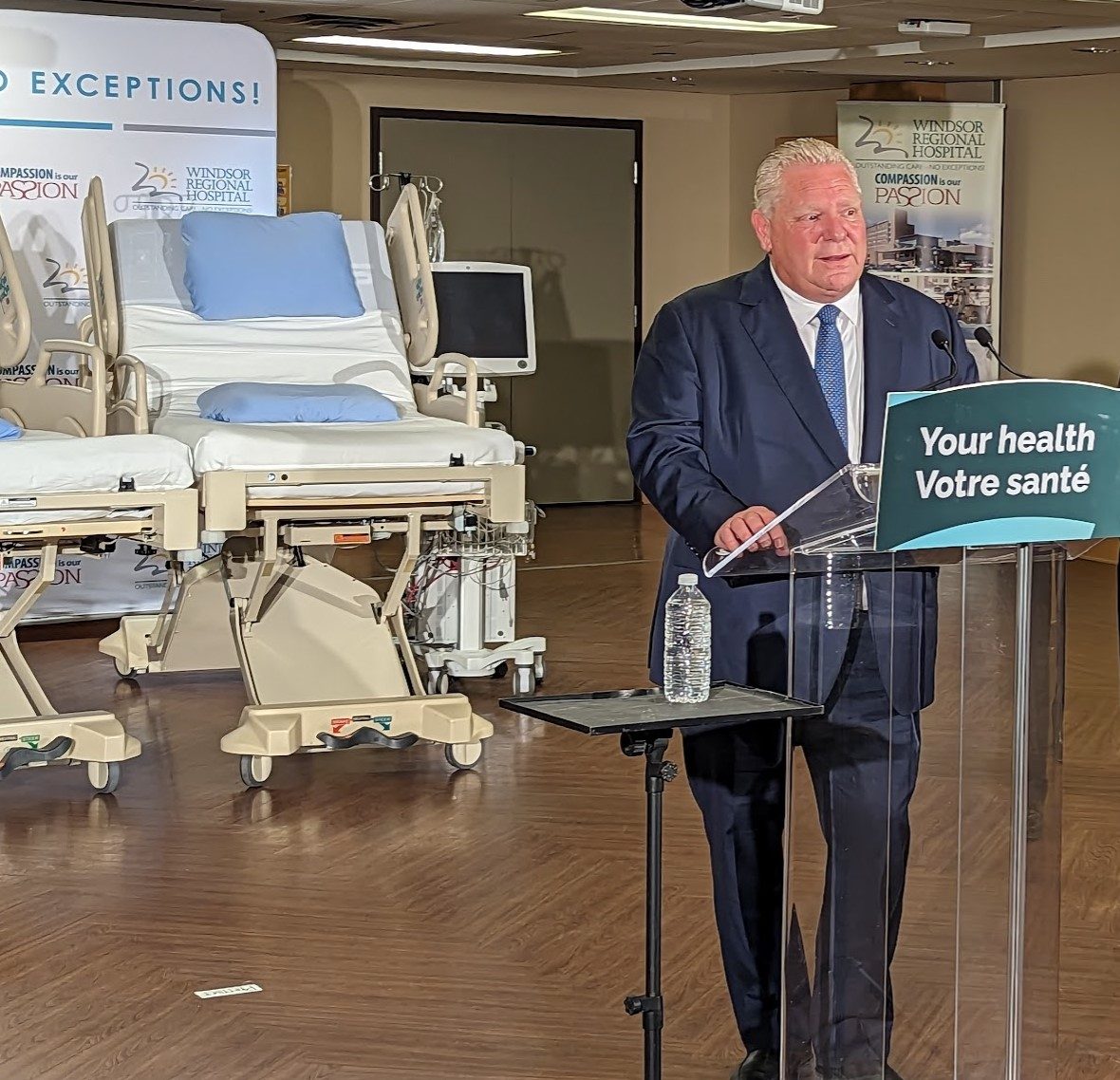
Doug Ford isn’t a free-market, small-c conservative, no matter how many times he says it or how many signs he puts up declaring that Ontario is Open for Business.
Doug Ford is a central planner, the likes of which would make a Soviet blush a deeper shade than Moscow Red.
When I saw him recently responding to new federal NDP Leader Avi Lewis about his proposal to ban surveillance pricing at grocery stores, I couldn’t help but blow a gasket (or drop my grocery basket) at the sheer nonsense of the Premier’s statement. Ford essentially dismissed the idea as nonsense, said “God bless the Westons” (handing a massive, unforced PR win to the left and those who hate the Westons bipartisanly), and then dropped the kicker, saying that he was a free-market capitalist who wouldn’t intervene.
He loves to use the phrase let the market dictate, but his actions speak differently. This is the same Premier who sets strict minimum vice pricing for alcohol, cannabis, and tobacco. This is the same Premier who used the powers of a majority government to shutter independent businesses during COVID-19, essentially imposing economic martial law while letting big-box stores stay open. The list is endless.
The examples of Doug Ford’s central planning forays are well-known to political observers. From his COVID interventions, to EV subsidies, to paying off every voting-age Ontarian with $200, Ford is more than willing to use tax dollars to pick winners and losers. Ultimately, the winners are him, his circle, and his donors. This has been proven through media exposés, questionable government contracts, and resignations that followed the ongoing Greenbelt scandal.
The truth is, Doug Ford doesn’t hate socialism or communism, just like his base doesn’t hate it when it benefits them. They all just hate the words, not the definitions.
A true free-market Ontario would look radically different. If Doug Ford wanted to truly accept the tenets of Adam Smith and Milton Friedman, he would immediately blow up the LCBO and OCS wholesale monopolies, allowing cannabis and alcohol to be sold wherever any other product is sold. He would stop allowing Minister’s Zoning Orders (MZOs) to benefit certain developers, regions, and cities over others, stopping the use of this special tool to ignore existing legislation and regulations. It would be a fair playing field for all.
A true small-c conservative would not intervene locally with planning decisions or school boards, but he constantly does or allows the opposite. The most galling example is the implementation and extension of Strong Mayor powers – something no one asked for, yet most communities are still grappling with. He would even reject federal funding for healthcare if it meant truly expanding private healthcare delivery in new, innovative ways.
Abandoning our status quo and existing orthodoxy would be reckless and risky, however, it would be the only way to truly implement free-market capitalism and small-c conservatism, which we are currently far away from.
He certainly isn’t a fiscal conservative, either. From running multi-billion dollar deficits annually while cutting revenue streams like license plate sticker fees, to borrowing money to buy electoral prospects, these are not fiscal moves. These are rash decisions that risk the house to pay for a second pool.
While Ford rolled the bottles out of the LCBO and into the corner store, he stopped short of breaking the LCBO and Beer Store monopolies on wholesale and distribution respectively. He spent $200 million of taxpayer money just to break the contract early with the Beer Store. Now, beer stores are shutting in almost every community, and Ontarians are losing access to bottle returns, even though the Beer Store still retains the existing government contract for recycling deposits.
It’s been an exercise in dropping a 24 of Molson down a flight of stairs and expecting someone else to clean it up, while we’re all stuck smelling the putrid, lingering effects.
Ford’s actions regarding small businesses speak louder than his words. Annually, the Canadian Federation of Independent Businesses (CFIB) lists suggestions to his government which are ignored, and while some advocates are heard, actions are incremental, if they happen at all.
He is a sloganeer who is very good at it. He knows how to come up with a slogan and slap it on a pamphlet, sticker, poster, placard, or billboard – which makes sense considering that’s the family business. But the family business is also government; he’s part of an existing and ongoing political dynasty. He needs to move past the slogans and folksy charm. But maybe he doesn’t want to actually be a small-c free-market capitalist. Maybe he’s happy being a showman packaged and sold on printed goods.
And look at his legacy projects. From Highway 413, to uploading the DVP, to 401 tunnels, to Ontario Place, and now the Billy Bishop airport expansion plan, Doug Ford hasn’t met a project he can do to Toronto that he won’t champion and become the face of. In a way, Ford is a lot like President Trump, who is actively working to reshape the D.C. skyline. Both men should’ve just run for mayor of the respective cities they love – Toronto for Ford, and Washington for Trump – and stayed at that level.
The opposition parties can’t call out this central planner hypocrisy because they are suffering from a trifecta of problems: First, they lack meaningful leaders who can connect with the electorate. Second, they are reflexively oppositional, meaning they oppose Ford and his ideas even when those ideas resonate with voters, making them come off as out of touch. Third, they lack meaningful ideas of their own. They are so focused on unseating Ford that they don’t have a focus on improving the lives of Ontarians beyond that sole focus.
It’s not a good look, or a good strategy. The opposition parties can’t call him out because they are vulnerable to the charge of being central planners themselves, inherently because they exist on the left-wing of the political spectrum. They’re afraid of being called hypocrites because they have shame.
Ford has no shame, just like Trump has no shame. A good friend and political operator once taught me a lesson that I won’t forget anytime soon: in politics, shame is a weakness. The opposition parties need to shed their fear of shame to be cunning and effective political operators; not only able to take down political opponents but also offer a meaningful alternative.
Voters keep buying the printed goods instead of small-c policies or progressive substance because they don’t care. They’re happy being bought off. They see someone fighting for them, not for the academics, elites, media, or USMCA negotiators. They see a folksy man they’d like to eat a burger in a backyard with – and even those who hate Ford the most won’t admit it publicly, but they would be more than happy to share that burger with him too. Maslow’s Hierarchy of Needs is a simple concept, and Ford knows how to feed and deliver it like a backyard chef at the BBQ cookout.
Ontarians moving forward should expect more of the same. There is no reason to think the man is going to change. A leopard doesn’t change its spots, a cheetah its stripes, or an 800-pound gorilla its ability to consume all the attention in the room.
Actually, given his track record, an 800-pound white elephant is probably more apt.
This can be heard on Spreaker, Spotify, iHeartRadio, Amazon Music, or other podcasting platforms.
Kvetch with Jon Liedtke is a podcast of all of my radio interviews, reporting, commentary, media interviews, and more!
Leave a Reply