
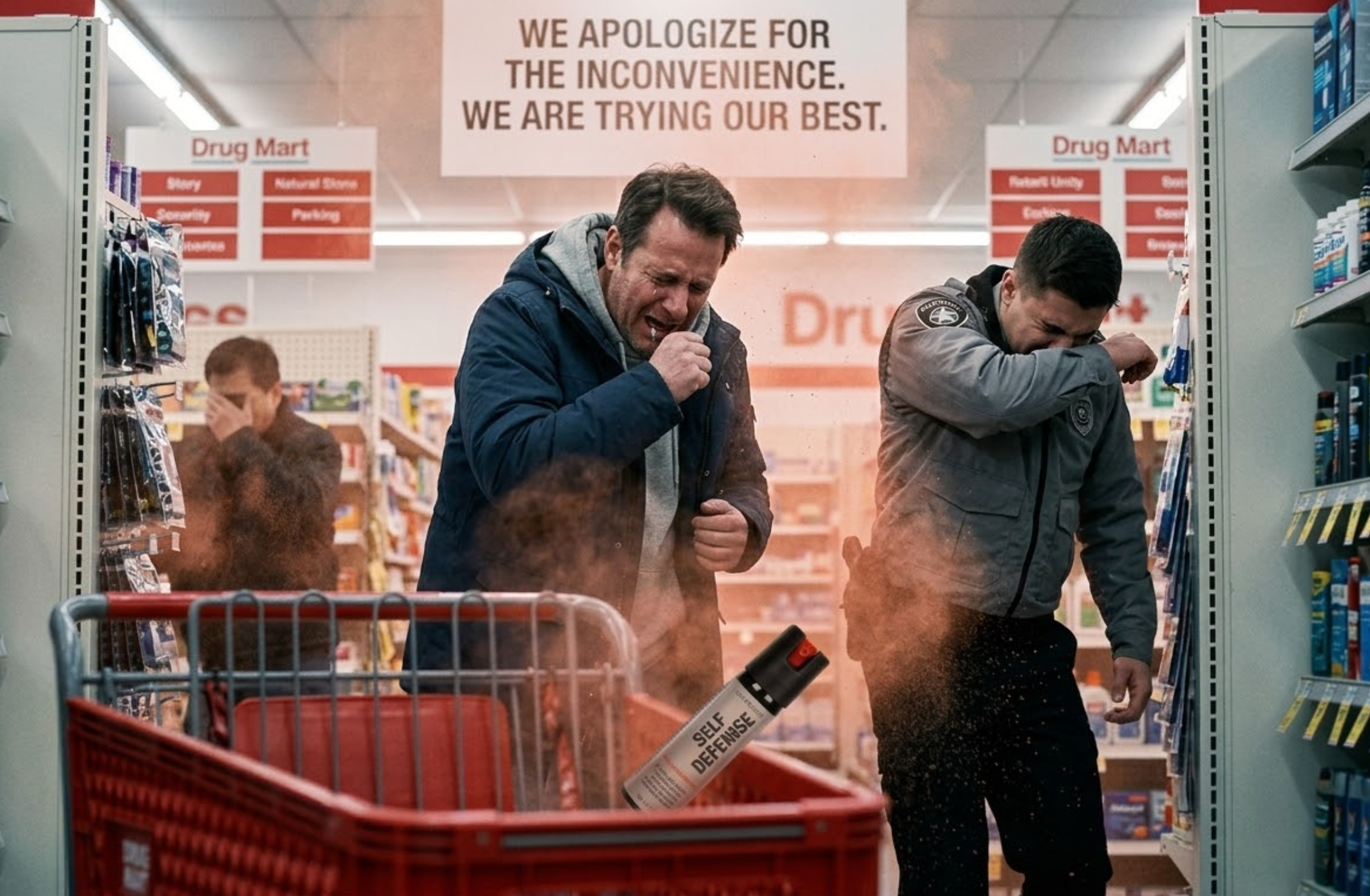
Jon Liedtke joined Gene Valaitis on 610 CKTB and critiqued Premier Doug Ford’s retail security proposal, characterizing it as a “Wild West” approach that shifts the burden of safety from the state to individual citizens. He argued that suggesting the use of pepper spray in retail environments is an admission of policy failure regarding the police and court systems, raising significant concerns about public liability and the safety of discharging such substances in enclosed spaces like grocery stores.
Liedtke further highlighted the disconnect between the provincial government and law enforcement, noting that the Ontario Chiefs of Police Association was not consulted on the plan. Instead of arming underpaid security guards, he pointed to success stories in Windsor where data-driven policing and dedicated retail theft departments have effectively reduced crime through collaboration with businesses.
Transcript (Gemini Generated):
Gene Valaitis: One of the great storytellers on the show, we love having him on, is former newspaper publisher and broadcaster Jon Liedtke is here. And Jon always sends me interesting emails and he says, “Gene, today I want to talk about buck-a-beer to boutique bounty hunters, Ford’s Wild West retail plan. I have an inkling we’re going to talk about Doug and pepper spray.”
Jon Liedtke: Good morning, Gene. Welcome to the Mad Max phase, I guess, of the Doug Ford government. We have moved from fixing systems to arming individuals. I guess the Premier looked at the $5.5 billion police budget and said, “I don’t know what to do. It doesn’t work. I can’t guarantee you’re not going to get mugged at the mall, so here’s a can of hot sauce. Good luck.” I mean, we’ve gone from “Open for Business” to “Armed for Business”? I mean, talk about that in record time.
Gene Valaitis: Yikes.
Jon Liedtke: I mean, this—it’s just—it’s honestly quite silly here. He’s saying quite frankly, “I can’t fix the courts, I can’t fund the police adequately, so it’s up to you. Try not to get some Mace in your eyes.” This is a total admission of policy failure. If the Premier is telling you that you need a weapon to go buy milk at the grocery store, he’s telling you that his Premier suit isn’t working anymore.
Gene Valaitis: Yeah. Well, you know, I—I think one of the big problems is that we need bail reform because what—what happens to these bad guys when they do smash-and-grab robberies is, you know, they get arrested, but they’re out on bail the next day and then they re-offend. And I—I realize that the—the jails are filled full of people, but Doug is now saying give everybody pepper spray and build more jails. I don’t think it’s going to solve the problem.
Jon Liedtke: I don’t think it’s going to solve the problem either. Um, it’s really, as I said, it’s just—it’s a total admission of policy failure here. I don’t understand it. I mean, I recognize that there is a need for bail reform beyond the bail reform that we had under the Trudeau government that’s created many of the situations that we’ve seen here with the revolving-door cycle of criminal justice. And that needs to be dealt with, but the situation—it can’t be dealt with by just simply throwing your arms up and saying it’s up to every citizen to deal with on their own.
Now, listen, are there merits to having it? Pepper spray? Sure, maybe. But I heard your last guest that you had on talking about, you know, imagine how the Al-Quds Day event could have gone if everyone had pepper spray.
Gene Valaitis: Yeah.
Jon Liedtke: I mean, you—or imagine in a situation like a Shoppers Drug Mart where someone decides to discharge in an enclosed space. You’re talking about a lawsuit that could bankrupt a municipality.
Gene Valaitis: Yeah. And—and when it comes to drugstores and retail outlets, um, you referred to the situation, the problem we’re having, as the “shadow police force.” What do you mean by that?
Jon Liedtke: Well, I mean, he was talking yesterday at the presser about wanting to give security guards, quote, “real power” to arrest people. Um, we already have that power; in the Criminal Code, it’s called “citizen’s arrest,” Section 494 or 495, I believe. What he’s looking at doing here—he’s talking about creating a shadow police force, and I don’t think that that’s necessary here.
Could you imagine a world where you walk in and you have 19-year-olds wearing security vests at Shoppers Drug Mart being treated like they’re Delta Force by the Premier? I mean, this—this is nonsense. You’re talking about giving police-level powers to $18-an-hour rent-a-cops with mall-level accountability? This is just—this is just beyond the pale. We need to have actual policy discussions. But this is what we talked about yesterday, Gene. The Premier, he’s so good at the—the bluster and the bravado, um, but the second that you decide to dive into it beyond with a little bit of introspection, it all falls apart like a house of cards.
Gene Valaitis: Yeah. Well, you know, um, I—I do have some knowledge about this because I’ve interviewed a lot of lawyers about the “stand your ground” laws, which we really need in Ontario and in Canada. But a lot of the reasons why there are security guards in drugstores and in—in other retail stores, it’s because of their insurance regulations, and they have to have one or two security guards on the floor.
Now, I remember being in an Apple Store because I, you know, new charger and, of course, they got changed around so I had to spend 150 bucks. And—and the security guard who was in there—and I’m sure she’s an absolute—just—I’m sure in her private life she’s an absolutely delightful woman—but I mean, the security guard was like soaking wet maybe 80 pounds, 5-foot-4, with a bulletproof vest on. And if a smash-and-grab robbery occurred in that store, I mean, what could she possibly do aside from, uh, run away, cry, or wag her finger at them and say, “Don’t do that, your mom would be so disappointed”?
Jon Liedtke: Well, and—and who wants them to actually engage, right? Because I’ve yet to hear of a security guard actually engaging in a situation like this. In most cases, they still sort of act with the hands-off situation. We live in this very concerning liability environment where nobody wants to really, you know, get their hands dirty, which is why it’s so surprising to see the Premier looking to get our hands dirty here. But look, you could just look down the 401 from where you’re at, Gene, down to Windsor, and we’ve got success stories here.
Gene Valaitis: Tell me.
Jon Liedtke: Yeah. So Windsor, we launched, um, with our Windsor Police Service—our Windsor Problem-Oriented Policing—also launched a dedicated retail theft department, which is staffed by a specific officer. And what they do is they work directly with retailers, and what they—they help them file police complaints, which is one of the biggest things. Um, then they help them follow up. They guide them through the whole process so it’s not just a black box.
And gosh, Gene, they’ve found some really, really great success stories from this. For example, last year between just three days, December 3rd through December 6th, they partnered with 15 retailers. They arrested 32 people, laid 33 criminal charges, recovered $3,000 in stolen property, 19 counts of theft under $5,000, four counts of engaging in prohibited activity, three counts of failure to comply, one count of fraud under $5,000. This can be done, Gene. You don’t need to go and arm people in the Shoppers Drug Mart. We can just use actual data and known policing, uh, techniques to achieve success.
Gene Valaitis: A text messenger from the 289 says, “What we’re talking about with security guards, it’s called ‘detect, deter, and observe report.’ That’s the security motto. Not many companies still arrest anybody.” But you know, I was in a store—it was an LCBO—where somebody just walked out with a forty-pounder of vodka. And I said to the guy at the counter, I said, “Are you not going to do anything?” He said, “Dude, I make minimum wage and I’ve got two kids.”
Jon Liedtke: Yeah, and I can say ahead—anecdotally, that when we do hear reports in Windsor of the results of these types of, uh, engagements, we always noticeably don’t hear anything about the LCBO. And from what I’ve heard, again, anecdotally, is that the LCBO doesn’t work with the police on this program, they don’t provide the numbers of the theft, and I think it’s because it’s in such large numbers that it would look poor upon the government.
But again, this all comes down to one thing, Gene. Yesterday, the Ontario Chiefs of Police Association distanced themselves from this. They came out and said, “Whoa, whoa, whoa, whoa, we weren’t consulted on this. Give us some time to, like, put together a little thought plan, please.” When we have the police chiefs coming out and saying they’re finding out about things from Colin D’Mello tweets or Brian Lilley columns, we’ve got a problem here.
Gene Valaitis: [Laughs] Yeah, and we do. And we do.
Jon Liedtke: So I mean, listen. We’ve gone from “Protecting Ontario” to “Protecting the Narrative.”
Gene Valaitis: Yeah. Can I get you some freshly ground pepper spray with that steak, Mr. Liedtke?
Jon Liedtke: Only if it goes with fresh butter.
Gene Valaitis: Okay, yeah. Churned while running. Wow, what a first hour. Jon, you’re a great storyteller. Thanks once again, as usual. If we don’t talk to you before, we’ll be talking to you next Tuesday, okay pal?
Jon Liedtke: Cheers, Gene.
Gene Valaitis: There he goes. Jon Liedtke. Love having him on the show.
This aired on 610 CKTB
Follow Gene on Twitter or LinkedIn
Leave a Reply